The Honest Problem Nobody Wants to Say Out Loud
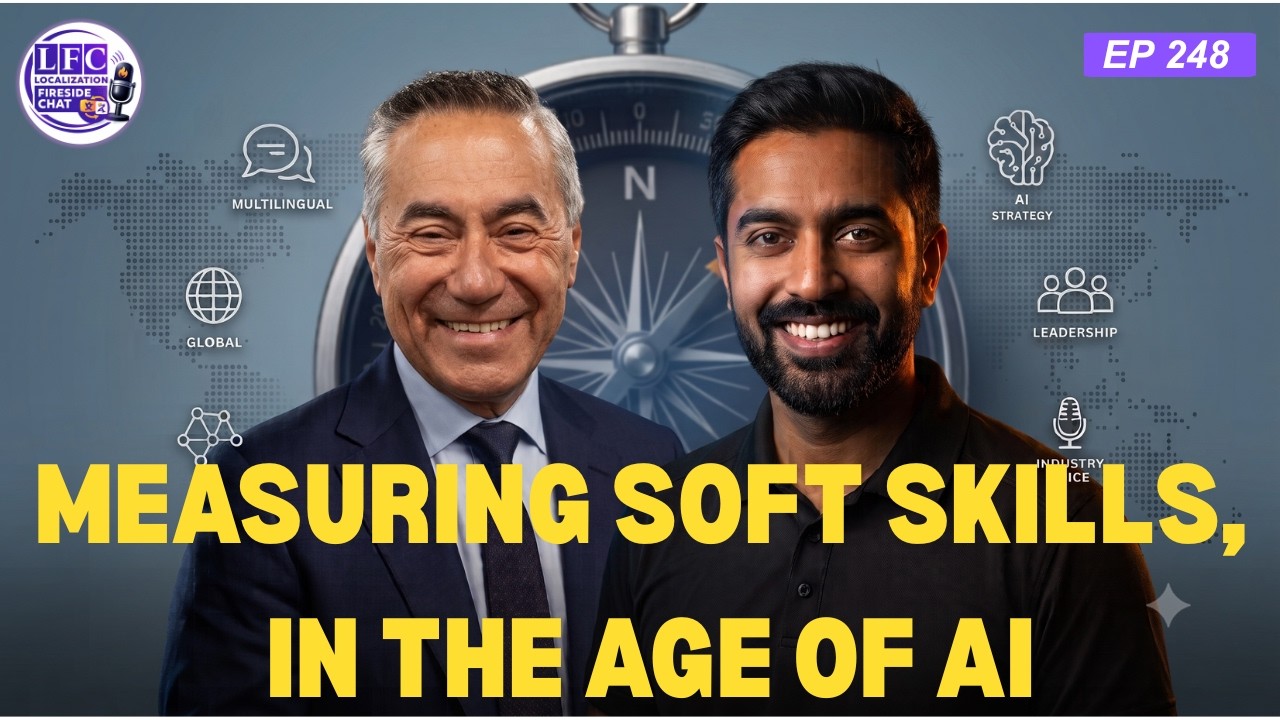
There is no shortage of AI enthusiasm right now. Demos look incredible, boardrooms are pushing mandates down the chain, and everyone is scrambling to show they are doing something with the technology. What gets talked about far less is why it is quietly failing inside real organizations. That is exactly where episode 248 of the Localization Fireside Chat goes, and it is a conversation worth sitting with. Robin Ayoub welcomed Sameer Ranjan, CTO and Director of Data Science at Catenate, a US patent holder for an algorithm that quantifies soft skills and personality patterns, and a professional who has moved through mining engineering in India, McKinsey, the American Heart Association, and now AI product development. That is not a straight line career, and that is precisely the point. The people who have taken the long road tend to have better instincts about what breaks.
Sameer describes the pattern he keeps seeing: a boardroom gets excited, pushes an AI mandate downward, and the people on the ground who have been running the same process for twenty or thirty years have no framework for translating that mandate into something real. The easiest response becomes generating documents, longer emails, padded reports. As Sameer puts it, whatever could have been done in two lines becomes four paragraphs. Spending increases, ROI stays flat, and leadership concludes the technology does not work. The actual problem, he argues, is that organizations skipped the process step entirely. AI is supposed to change process, process affects people, and people require real buy-in. None of that happens on a three-week timeline, and no amount of prompting replaces the two or three years it genuinely takes for enterprise adoption to produce meaningful data.
What Measuring Soft Skills Actually Means
The conversation shifts into the work Catenate is doing, and this is where it gets specific in ways that most workforce technology discussions avoid. Sameer built an algorithm, now protected by US patent 12,198,213 B2, that quantifies 84 distinct soft skills and maps them against personality patterns to generate career direction guidance. The key design decision was rejecting the standard strongly-agree-to-strongly-disagree format in favor of situational ranking questions drawn from real life. You encounter an old friend at a casino you have not spoken to in a decade. What do you do first, second, third, fourth? The answers, measured against standard deviation patterns across a continuous assessment cadence of every three months, build a picture of who someone actually is rather than who they think they should say they are.
Robin draws a sharp comparison to legacy tools like Myers-Briggs and the PI Index. Sameer distinguishes Catenate clearly: those tools aim at general personality understanding for any context, while Maya, Catenate’s flagship product, is anchored entirely in behavioral economics and aligned to career, job fit, and education. The system does not tell an organization who to hire. It hands decision-makers enough granular data to make a genuinely informed call, including understanding which soft skill combinations contradict each other, because nobody scores a ten on everything, and the gaps are often as revealing as the strengths.
Where This Actually Connects to Localization
For the localization industry specifically, Sameer’s framing lands hard. He makes the case that AI generation saves time but cannot replicate hyperlocalization, the layer of cultural instinct that only a human can read and adjust. The example he reaches for is sales: a great salesperson succeeds not because they have the perfect script but because they read the emotional nerve of the person across from them. No camera, no algorithm, and no assessment can replicate that. Generate freely, he says, but keep a human in the loop at every stage where culture, emotion, or judgment is at stake.
The same logic applies to the people decisions that localization companies face constantly: who to promote, who to trust with a high-stakes client relationship, how to build a team that actually functions. Those decisions still feel opaque and subjective to most managers, but Sameer’s argument is that they do not have to be. Data-assisted decisions are wiser decisions, the same way reading widely or listening to enough podcasts makes any person better calibrated over time. The tool does not replace the human. It validates the human’s instinct with something measurable enough to defend.
If this conversation landed for you, the full episode is worth your time in whatever format works best. Watch on YouTube if you want the full visual conversation, or Listen on Simplecast if you prefer audio on the go. Either way, Sameer brings a rare combination of technical credibility and ground-level honesty to a topic that most people in this industry are only willing to discuss in polished, optimistic terms.


Leave a comment