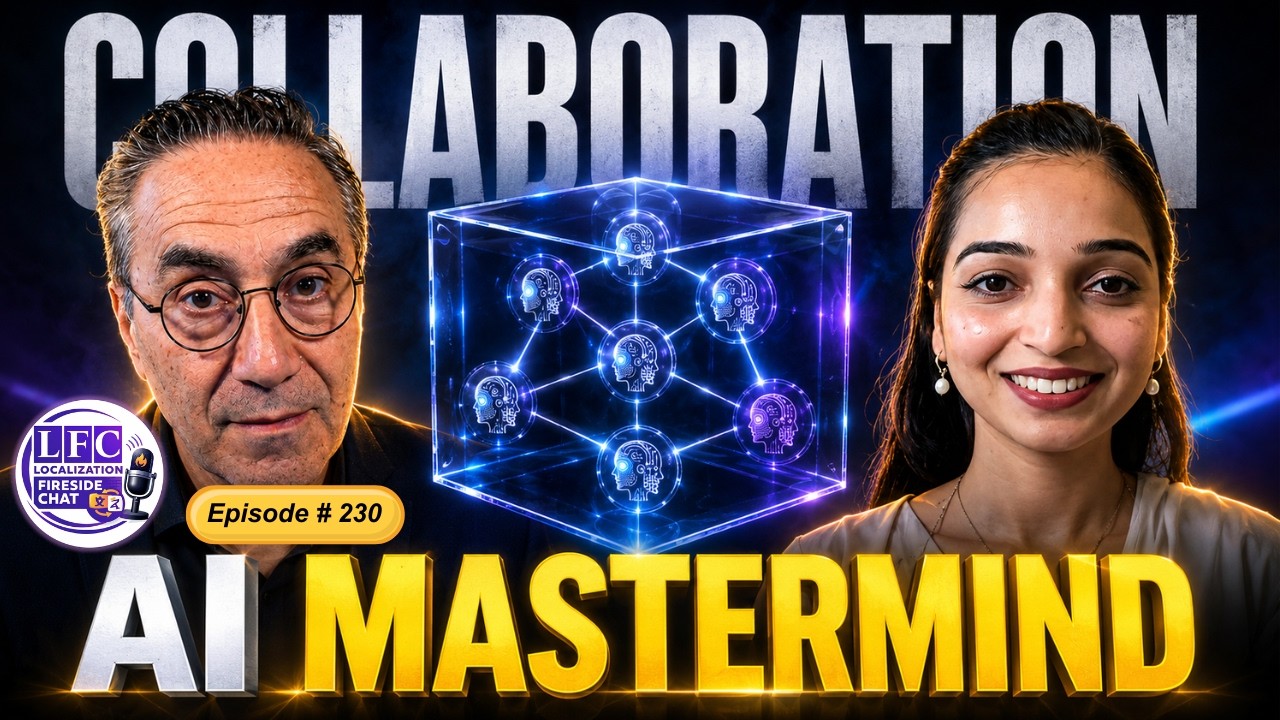
The AI Mastermind Effect: Why Multi-Agent AI Changes Everything
What if your AI didn’t just answer your question — but had three other AI agents check the answer, challenge it, and verify it before you ever saw it?
That is the idea at the heart of Bloomstack, and it is what Damini Delisle, Chief Executioner at Bloomstack, calls the AI Mastermind Effect. In this episode of the Localization Fireside Chat, Robin Ayoub and Damini explore why multi-agent AI collaboration is the future, why AI-driven burnout is already an epidemic, and what a permaculture food forest has to teach us about building better technology.
From Hyundai Cars to Chief Executioner
Damini’s journey is unlike most people you will meet in the AI space. She started her career selling Hyundai cars in India — admittedly knowing nothing about cars — and discovered that what she was really learning was people. That curiosity about human behaviour led her into marketing, design thinking, and eventually to Bloomstack, where she met founder Eric Delisle and helped rebuild the company from the ground up during COVID.
Bloomstack started as an ERP platform serving the legal cannabis industry. When COVID hit and clients disappeared, Eric made a bold pivot — ditching a 40-person team, going into stealth mode with just himself and co-founder Felipe, and spending four years quietly building what is now a multi-agent AI collaboration platform. Damini, meanwhile, was discovering permaculture, growing a food forest, and learning that the most profound lesson in nature is also the simplest one: just toss the seed.
What Is the AI Mastermind Effect?
Most people interact with AI as a single agent — you ask ChatGPT something, it answers. You ask Claude, it answers. One voice. One perspective. No verification.
Bloomstack’s approach is fundamentally different. Instead of one agent, you have multiple — each running a different model, each with a defined role. One might be the angel, inclined to agree. Another is the devil’s advocate, designed to challenge. A third might be Perplexity, checking facts. A fourth might be Claude, flagging what the others missed.
The result is what Robin described as benchmarking outputs across models to arrive at a mastermind answer — a higher-confidence result that no single model could produce alone. As Damini put it, when you and I collaborate, we bring more than either of us has alone. The AI Mastermind Effect applies the same principle to machines.
Glass-Box vs. Black-Box AI
Most AI tools operate as black boxes. You put something in, something comes out, and you have no idea what happened in between. No auditability. No traceability. No way to verify.
For a blog post or a casual message, that might be fine. For a business decision, a regulated communication, or a high-stakes executive output, it is a serious risk. Every piece of communication a company puts out carries a price tag — monetary, reputational, or both.
Bloomstack’s glass-box approach means every step of the multi-agent process is visible. You can see what each agent said, where it disagreed, and how the final answer was reached. For CEOs who cannot afford AI mistakes, that transparency is not a nice-to-have. It is the whole point.
The AI Epidemic: Doing More Is Not the Point
Damini named her June 11 summit the AI Epidemic: Building for Life — and the name is deliberate. AI was supposed to give us back time. Instead, what happened in most organisations is that the four hours AI saved you became four hours your employer expected more output from you.
As Damini put it bluntly: AI tools are telling everyone to be more productive, do more, scale more. But we are not meant to do more. We are meant to go out, hang out, plant trees, have a family dinner, swim in the water.
Robin connected this directly to the localization world — compressed timelines, exploded volume expectations, and workers given AI subscriptions and told to do the work of ten people. The epidemic is not the technology. It is what we are choosing to do with it.
What Permaculture Taught Damini About AI
On her first day of permaculture class, Damini’s teacher walked in, picked up a seed, and tossed it on the ground. That is how you plant it, he said. Because that is what happens in nature.
Everything else — the three-inch depth, the sideways placement, the careful soil coverage — was human complication layered on top of a system that already worked. Nature has been running experiments for millions of years. It has already solved most of the problems we are trying to solve.
Damini carries that principle into her AI work: observe first, replicate what works, resist the urge to over-engineer. The first principle of permaculture is observe. It is also, she argues, the first principle of building AI systems that actually serve people.
Art, Grounding, and Slowing Down
In a conversation full of ideas, one of the most memorable moments came near the end when Damini held up a lamp she had made from a bottle gourd she grew in her own food forest. It was not a metaphor. It was a physical object she had grown, harvested, and turned into something beautiful.
Art slows you down, she said. There is no fast art. And in a world where the pace is relentless, having something that centers you — whether it is cooking, painting, walking, or growing your own food — is not a luxury. It is survival.
One Thing Every Executive Should Do Differently
When Robin asked Damini for the one action she wants every executive to take after listening to this episode, her answer was simple: be mindful. AI is powerful. It is a genie. But what you ask of it matters. And how you ask it matters even more. Before implementing anything, find your community. Talk to people you trust. Trust, but verify.
Listen to the full episode on Simplecast | Watch on YouTube | Connect with Damini Delisle on LinkedIn | Visit Bloomstack | Register for the AI Epidemic Summit free: bloomstack.com/lifesummit | Connect with Robin Ayoub on LinkedIn | Visit N49Networks | Book time with Robin via Calendly


Leave a Reply