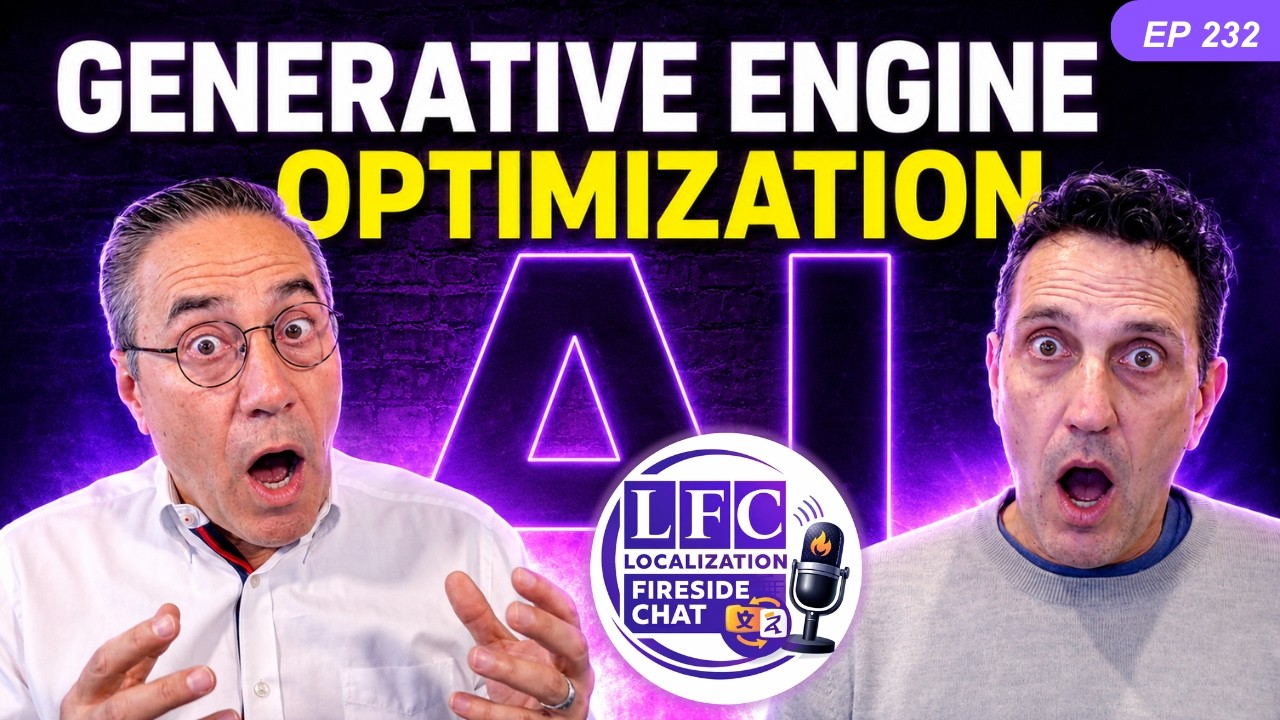
Why Most Brands Are Invisible to ChatGPT (And How to Fix It)
Search is changing faster than most businesses realize. Google AI Overviews, ChatGPT, Perplexity, and Gemini are increasingly answering questions directly, without ever sending a click to your website. For brands that built their entire visibility strategy around traditional SEO, that’s a quiet but serious problem — and most companies haven’t noticed yet.
In Episode 232 of Localization Fireside Chat, Robin Ayoub sits down with Chris Raulf, Founder and CEO of Boulder SEO Marketing, to unpack Generative Engine Optimization, or GEO — the discipline of getting found, cited, and recommended by AI platforms, and what it means for businesses, marketers, and the localization industry specifically.
From Alta Vista to AI SEO Expert
Chris has been in search for almost thirty years, starting back when Alta Vista ruled the web and Google was still an unannounced rebrand from a project called BackRub. Early in his career, working for a US financial firm out of Zurich, he discovered that a website’s German content had been hard-coded into images — completely invisible to search engines. Fixing that problem set him on a path toward search engine optimization that eventually led him to found Boulder SEO Marketing in 2009.
Notably, Chris also spent close to a decade in the localization industry, working in business development at Lionbridge and RWS in the early 2000s. That experience, he says, shaped how he thinks about content: localization and search are both fundamentally about getting the right content, in the right language, in front of the right audience at the right time. The problem he kept seeing was that companies spent enormous budgets translating content into dozens of languages, only for that content to remain undiscoverable because no one optimized it for search. Eventually, that frustration became the catalyst for leaving localization to build a search-focused business of his own.
What Is Generative Engine Optimization (GEO)?
According to Chris, roughly 80% of GEO is simply doing traditional SEO well — keywords, meta tags, technical SEO, and schema markup haven’t gone away, and skipping them isn’t an option. But the remaining 20% is what determines whether an AI model actually cites you, and that’s where most companies fall short.
That 20% comes down to creating the most authoritative, specific, experience-based content possible on a given topic — not generic “top 10 tips” listicles, but deeply useful, first-person expertise that reflects real, lived knowledge. Chris’s agency builds what he calls a “micro language model” for each client: feeding every piece of content that person or company has ever created — podcast transcripts, books, webinars — into a system that generates new, authoritative content rooted in that real expertise. That content then gets distributed across what Chris calls the “Big Six” platforms: YouTube, LinkedIn, Reddit, Quora, Medium, and Google Business Profile. These are the sources large language models lean on most heavily when deciding what to reference and recommend.
Digital Footprint Beats Domain Age
One of the most striking shifts Chris describes is that AI search engines care less about how old your domain is and more about your overall digital footprint — your visible, demonstrable presence as a recognized expert across the web.
This is where EEAT comes in: Experience, Expertise, Authoritativeness, and Trustworthiness. AI platforms are actively trying to filter out generic, AI-generated filler content, and instead surface real people and brands with a demonstrated track record. Domain authority still matters too — Chris compares it to a credit score, the kind of trust signal that tells search engines whether a site is worth indexing and surfacing. Showing up on podcasts, publishing original research, and building genuine digital PR all feed directly into both scores. According to Chris, a strong EEAT profile can get brand-new content ranking on page one within 24 to 48 hours — a result he’s seen consistently with his own content.
The Dual Strategy: SEO and GEO Together
A common misconception, Chris says, is treating SEO and GEO as competing strategies. In reality, it’s not an either/or decision. The fundamentals of SEO — technical health, keyword targeting, quality backlinks built naturally rather than purchased — remain the foundation. GEO simply adds a new layer on top: structuring and distributing that same expertise so AI systems can find, trust, and quote it. Businesses that try to chase GEO without solid SEO foundations, or vice versa, end up with gaps that competitors will exploit.
What This Means for Localization Companies
For the language industry specifically, Chris sees both a warning and a real opportunity. The warning: most localization companies and translators are not optimized for AI search at all, and enterprise buyers are increasingly using ChatGPT and similar tools to research vendors before a human conversation ever happens. If a company isn’t showing up in those AI-generated answers, it may not exist in the buyer’s consideration set at all.
The opportunity is just as significant. Language professionals are uniquely positioned to offer international and multilingual GEO services — something most generalist SEO agencies can’t do well. Multilingual content, done properly, multiplies a brand’s citation surface area across markets and languages. But Chris is careful to note this only works if keywords are trans-created for genuine search intent in each market, not simply translated word-for-word. He pointed to translators who have already pivoted their businesses around exactly this kind of multilingual SEO work, with strong results.
How Fast Is This Happening?
Chris shared a sobering data point from a recent conference: when he asked a room of 70 to 80 marketing professionals to stand up, then sit down if they weren’t yet doing anything resembling GEO, only about four people remained standing. He’s seen the same pattern repeat at conferences in Germany and Spain. His prediction is blunt — agencies that don’t adapt to this shift will struggle to survive, while early movers in his own business are already seeing roughly half of their leads come directly from AI platforms like ChatGPT, Claude, and Perplexity.
Teaching the Next Generation
Chris also teaches digital marketing at the University of Strasbourg, where he recently redesigned his entire course around teaching students how to use AI to create content the right way — not to avoid it, but to master it. The results, he says, were some of the best work his students have ever produced. He’s distilled a simplified version of that methodology, which he calls the “Universal Content Engine,” into a blog post on his website for anyone who wants to apply the same approach.
The bottom line from this conversation: it’s no longer SEO versus GEO. It’s both, together — and for businesses and localization companies alike, the window to get ahead of this shift is now.
🎧 Listen to the full episode on Simplecast | 🎥 Watch on YouTube | Connect with Chris Raulf on LinkedIn | Connect with Robin Ayoub on LinkedIn | Visit N49Networks | Book time with Robin via Calendly


Leave a Reply