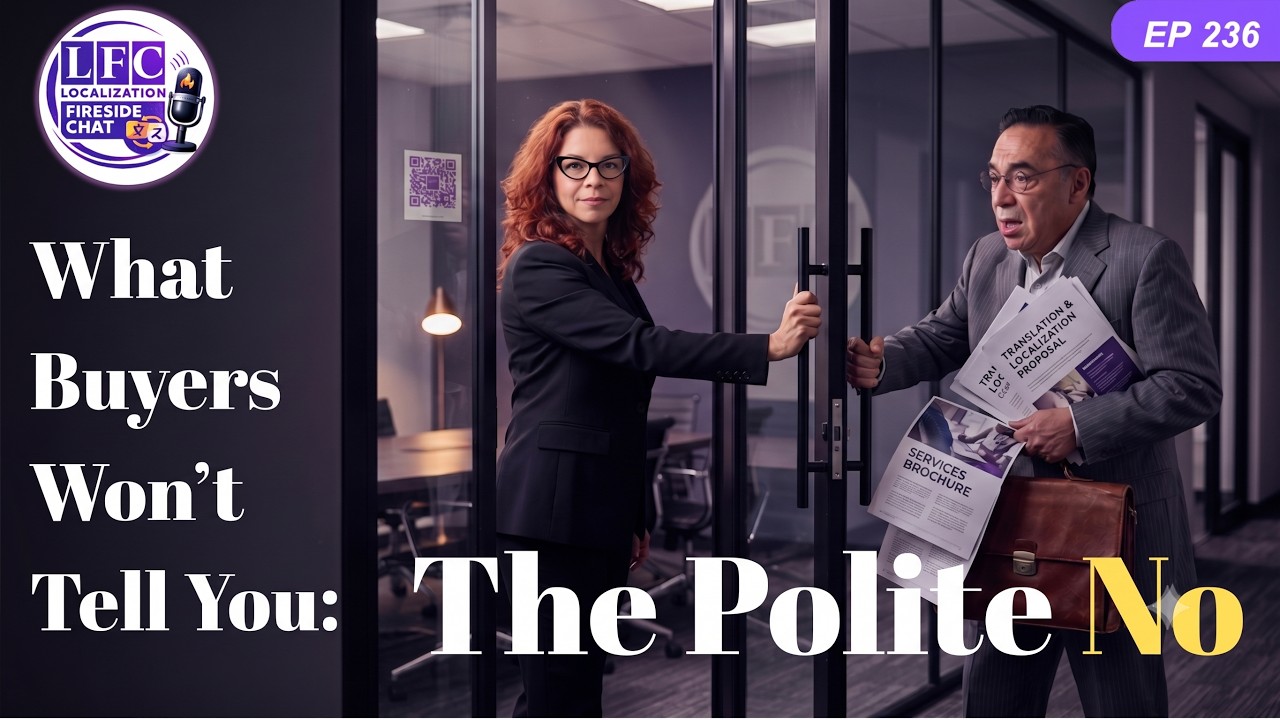
The Polite No: What Buyers Really Think of Localization Sales
We spend a lot of time on this podcast talking about how translation gets done. The technology, the AI, the workflows. This episode is different. For once, we hear from the person on the other side of the table, the buyer who decides which vendors win the work and which ones get the polite no.
My guest is Wada’a Fahel, founder of LocVerse and a global experience leader who spent more than two decades on the client side, building localization functions from the ground up at Xerox, Harley-Davidson, and Zendesk across over 150 markets. She has hired the vendors, run the RFPs, owned the budgets, and walked away from suppliers who could not cut it. If you sell localization or language technology, this is a rare chance to see how your pitch actually lands.
The afterthought problem is partly our own fault
Every LSP loves to complain that localization is treated as an afterthought, the last box ticked before launch. Wada’a agrees the frustration is legitimate, but she pushes back on where the industry points the finger. The bigger issue, she argues, is that we are so busy explaining how great our solution is that we forget to listen. She described sitting through countless vendor meetings that were one-way monologues about native speakers and fuzzy matches, with no curiosity about the client’s actual business or pain points. Reading the room, she says, beats evangelizing every time.
Localizing an icon versus localizing at speed
The contrast between her roles is where the lessons live. At Harley-Davidson, she spent close to a decade building capability for a brand with more than 120 years of heritage, the only brand in the world that gets tattooed on people’s arms. Technical manuals could be handled by the large players, but marketing demanded a completely unorthodox setup. She hired riders who were bloggers as in-country reviewers because they lived the brand, and her transcreation budget dwarfed her compliance budget. In many cases the right call was to leave a headline in English rather than weaken it.
Then came Zendesk, right around COVID, a young and fast SaaS world where Slack was default and email felt retro. Harley launched once a year. Zendesk launched every quarter. The pace forced a bias toward speed and an entirely different vendor strategy. What stayed constant, she says, was her leadership philosophy: build trust, understand the business, and speak to stakeholders in their own language.
Customer-facing content gets no shortcuts
Asked whether there is a real difference between full-treatment localization and good-enough translation, Wada’a was unequivocal. Anything customer facing has to be published great, full stop. She shared a sobering story from her Harley years, when the language authorities in Quebec walked into dealerships, found mistranslated and missing French labels on helmets and gloves, shut the dealerships down, and confiscated the products. She still has the photos of the suspension notices. Compliance is not a checkbox you can cut corners on.
From cost center to a seat at the table
Localization leaders all want a seat at the strategy table, and most never get one. Wada’a secured multimillion dollar budgets consistently by never leading with localization jargon. She studied her leaders, learned what kept them up at night, and tied her narrative to their problems. At Harley, her line was simple: without localization, bikes do not ship. That single sentence touched finance, compliance, and sales all at once, and suddenly the room was paying attention. The lesson for vendors is the same. Do not show up with a generic operations update. Tell the business story.
Behind the buyer’s curtain
This is the segment vendors need to hear. Wada’a has onboarded dozens of LSPs, and she described reading the exact same paragraph from five or six vendors side by side in an RFP. Native speakers in country, glossary and terminology features, fast turnaround. That is not differentiation, she says, that is table stakes, and AI is making the sameness worse. The vendors who made her shortlist did their homework on her company and on her as a leader, led with data instead of empty claims, and told a story specific to her business. Often the real differentiator was not the brand at all but the people. Chemistry, responsiveness, and trust with a delivery team are what she carried from Xerox to Harley to Zendesk.
Why clients really leave, and how vendors win
It is almost never price, she confirmed. Clients leave when the same mistake repeats and the vendor responds with defensiveness instead of ownership. She gave failing vendors second and third chances because offboarding is painful, but a finger-pointing mindset ends the relationship every time. On the flip side, the vendors who made her look brilliant in front of executives did one thing: they overachieved. Delivering is the expectation. Overachieving is what gets you invited to present to leadership, because your buyer is effectively your inside sales manager. Make them look good, and they will expand you across the organization.
Her advice on how vendors sell is just as direct. Stop blasting automated outreach. When a prospect receives three nearly identical AI-written emails in a week, you are not building trust, you are creating noise. Lead with your own voice, read the room, and bring a genuine differentiator, or do not bother with the call.
The throughline of the whole conversation is a single shift in posture: stop selling, start listening. The buyers are paying attention. The question is whether the rest of us are.
Watch or listen to the full conversation below, and connect with Wada’a if her perspective resonates.
Watch the full episode on YouTube: https://youtu.be/s4eECKbsfEQ
Listen on Simplecast: https://localization-fireside-chat.simplecast.com/episodes/sales-the-polite-no-what-buyers-really-think-of-localization-sales-with-wadaa-fahel
Connect with Wada’a Fahel on LinkedIn: https://www.linkedin.com/in/wadaafahel/
Visit LocVerse: https://thelocverse.com
Follow LocVerse on Instagram: https://www.instagram.com/locverse_online/
Connect with Robin Ayoub on LinkedIn: https://www.linkedin.com/in/robinayoub/
Listen to all episodes: https://localization-fireside-chat.simplecast.com/
Want to be a guest on the Localization Fireside Chat? Book here: https://calendly.com/robin-ayoub/localization-fireside-chat-podcast-recording


Leave a Reply