When Your Career Becomes Your Identity
After 36 years as a radiologist at Hackensack University Medical Center and a volunteer clinical professorship at Columbia University Irving Medical Center, Dr. Harry Agress Jr. knew medicine inside and out. What he was not prepared for was the emotional weight of stepping away from a profession that had defined him for most of his adult life. That experience became the engine behind his book, Next Best Years, a work focused entirely on the personal and emotional side of retirement, deliberately leaving financial planning to others. As Harry explained in this conversation, most retirement books give the emotional dimension a single small chapter. He felt that gap was worth three years of writing and a decade of journaling to fill properly. For anyone who has ever introduced themselves at a dinner party by what they do rather than who they are, Harry’s framework lands with immediate recognition.
The Four Freedoms and the Permission to Start Over
One of the most practical and genuinely freeing ideas Harry shares is what he calls the four freedoms, a mental framework for releasing the psychological contracts that kept high-achieving people tethered to performance metrics long after they stopped being useful. Freedom from the concept of failure, freedom from others’ expectations, freedom from the need to be the expert, and freedom from defining yourself by monetary compensation. He arrived at the first freedom the hard way, spending four days at an exhibition talking to hundreds of people and selling exactly one print of his photography. Rather than treating that as evidence he should quit, he reframed it using Tyler Perry’s maze analogy: when a door shuts, you note what you learned and simply turn toward the next one. That shift allowed him to start donating his large-format metal prints to healthcare facilities instead, which turned out to be far more satisfying than chasing sales. His award-winning photography, rooted in a lifetime of visual thinking as a diagnostician, found its most meaningful outlet not in a gallery but on the walls of hospitals trying to create calmer healing environments. Robin and Harry also found a parallel in the podcast itself. Robin’s observation that removing financial expectation from the Localization Fireside Chat freed him to build something genuinely useful prompted Harry to point out, without missing a beat, that this is exactly what the fourth freedom looks like in practice.
Starting Before You Think You Need To
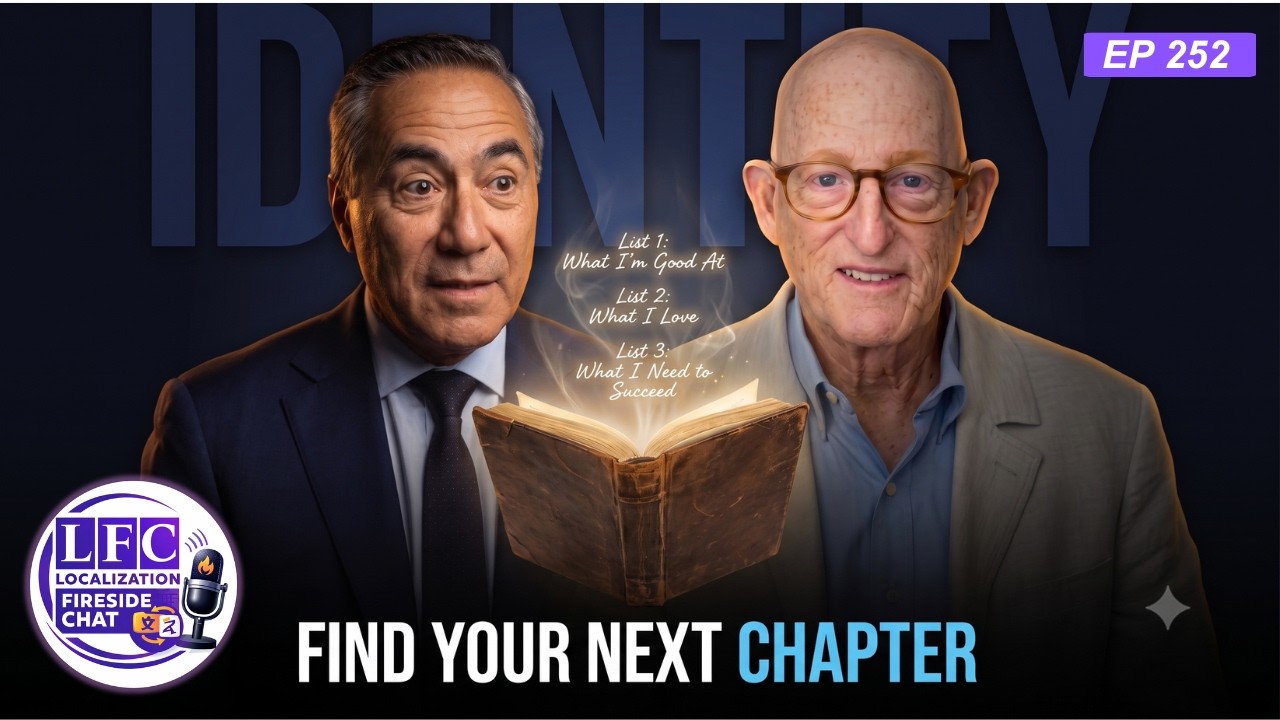
Harry is direct about timing: five years before retirement is not too early, and most people wait far too long. He recommends three concrete lists written privately, things you love, things that give you satisfaction, and things you are willing to try. A separate work pro-and-con list, which he suggests letting run long on the cons side by allowing yourself to acknowledge frustrations you have been suppressing for years, can clarify whether the pull toward something new is real or just fatigue. The stories Harry tells throughout the conversation are what make the framework feel lived-in rather than theoretical. A friend who gave up a medical residency and eventually became CEO of one of the largest pediatric hospitals in the country. A choir that sang at Canterbury Cathedral because a retired financial professional decided to try again. An illustrator whose anatomical knowledge from decades of editorial work led him to analyze pitching mechanics frame by frame and ultimately consult for twenty of thirty major league baseball teams. The throughline in every story is the same: the experienced brain, as Harry calls it, carries far more transferable value than people realize, and the only way to find where it applies next is to start trying things without demanding that those things immediately make sense or pay off.
If this conversation sparked something for you, whether you are five years from a transition or already in the middle of one, the full episode is worth your time. You can Watch on YouTube if you want the face-to-face energy of the conversation, or Listen on Simplecast wherever you consume audio. Harry’s book Next Best Years and his free starter resources are available at nextyearsbestyears.com, and his photography installations can be explored at harryagressphotography.com.


Leave a Reply