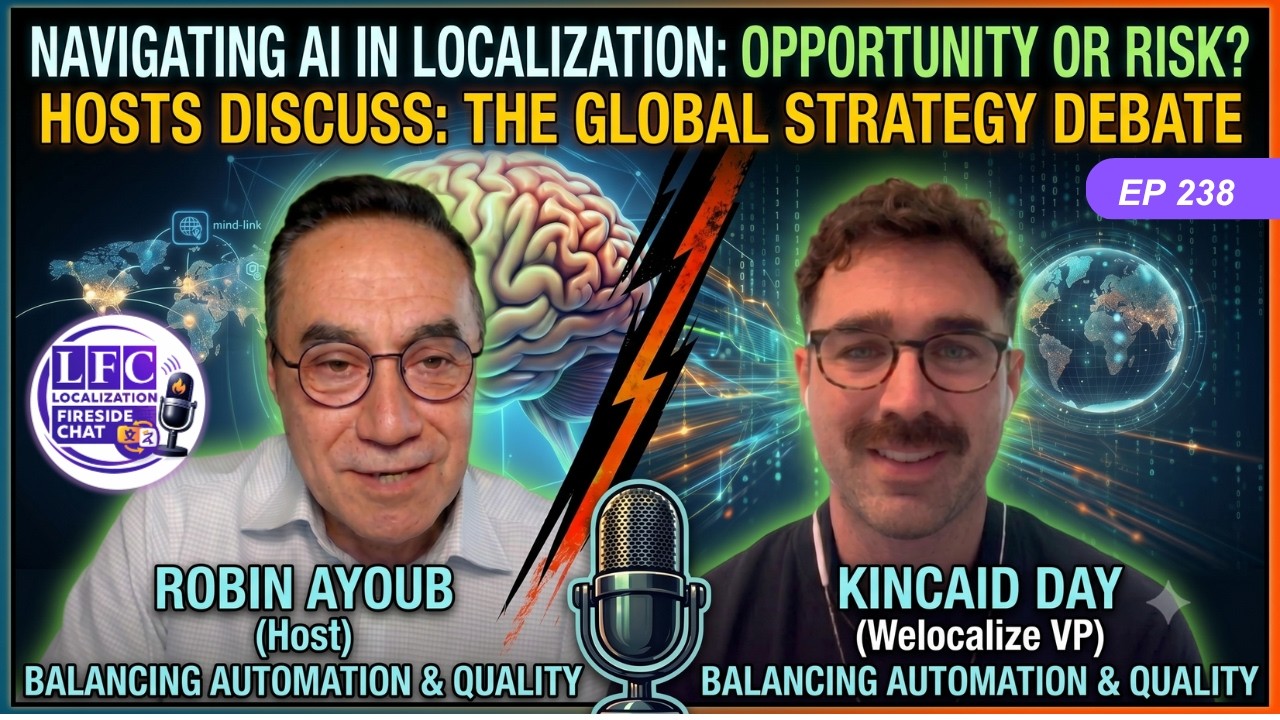
The Post-Editing Paradox: Why Better AI Made Human Review More Critical | Kincaid Day | EP 238
Most conversations about AI in localization are still happening in the future tense. This one is not.
In Episode 238 of the Localization Fireside Chat, Robin Ayoub sits down with Kincaid Day, VP of Global Strategy and Innovation at Welocalize, for a conversation grounded in 12 months of agentic translation running in live enterprise production. What they uncovered challenges some of the biggest assumptions circulating in the industry right now.
From Montana Farm Town to the Front Lines of Localization AI
Kincaid grew up in a small farm town outside of Billings, Montana, graduating with 47 kids in his class. He studied experimental music composition, moved to Seattle in his early twenties, and found his way into localization through video game testing and annotation work on a large campus in Redmond, Washington. By 23 he had a quota selling localization and AI services, back when it was still called machine learning, to some of the largest technology companies in the world.
From there he moved into pure-play localization technology at CloudWords, where he got exposure to the ROI side of the business. He worked with Fortune 100 companies processing content that was generating over one and a half billion dollars in revenue, and found that automation of the end-to-end pipeline raised one company’s revenue by six to seven percent simply by removing manual download, edit, and upload tasks from the workflow.
After stints in blockchain advisory work during COVID and co-founding a startup, Kincaid noticed that Welocalize had acquired CloudWords, reached out, and rejoined the company to help build out what would become Opal, their agentic translation platform.
What Agentic Actually Means in Production
The word agentic is doing a lot of unexamined work in the localization industry right now. Kincaid pins it down clearly. Opal combines three elements: neural MT, which still functions like a calculator executing specific tasks reliably; automated post-editing, or AIPE, which takes a client’s historical content, synthesizes and sanitizes it, and runs an initial editing pass; and AI quality estimation, or AIQE, which Welocalize has patented. Rather than simply telling linguists whether content is good enough to ship, AIQE functions as a risk categorization system. Thresholds are set per content type, per client, and the system directs linguist effort to where it matters most, locking down high-quality low-risk segments and flagging critical ones for human attention.
Opal also uses a model garden approach rather than committing to a single frontier model. The data science and quality teams continuously benchmark performance across languages and content types, swapping in the best available model as new ones are released, sometimes every two weeks. The customer always has the most optimized solution without taking on any of the technical overhead.
The Post-Editing Paradox
This is the counterintuitive finding at the heart of the episode. Common consensus says that if AI output reads well and performs well, you need fewer humans. The production data from Opal says the opposite.
As Kincaid explains, LLMs are excellent at grammar and fluency. Where they drift is on brand terminology, cultural references, and the specific vocabulary of a client’s product or market. The problem is that the content reads so well that errors are harder to spot. A mistranslation that would have been obvious in the MT era now reads fluently and confidently, and a reviewer moving quickly will miss it.
What Welocalize found is that they need more specialized linguists, not fewer and not more generalist ones. Linguists who deeply know the client, the product, the terminology, and the patterns of how AI produces content in that domain. These specialists are functioning as gatekeepers within the content workflow, ensuring that nothing fluent but inaccurate slips through and pollutes the reinforcement data flowing back into the system.
As Kincaid puts it, MT recycled historical content. AI has the freedom to think into what it does not know, and that is exactly why hallucinations happen. It fills gaps because it wants to execute the task.
AI Concentrates Expertise, It Does Not Replace It
Robin draws on his eleven years running Lionbridge Canada to frame the structural problem. The localization pyramid has always had junior translators at the base and highly skilled specialists at the top. If automation removes the base, where does the next generation of senior linguists come from?
Kincaid acknowledges this directly and calls it a philosophical problem he thinks about often. One of his colleagues, a former university professor who taught localization, stepped out of teaching because he could not in good conscience guide students toward entry-level positions that may no longer exist in their historical form.
The shift Kincaid describes is from generalist linguists to specialists embedded in a specific client, content type, or industry vertical. These linguists are essentially performing a data labeling function, the same kind of high-value annotation work that frontier labs now seek PhDs and domain researchers to perform. The entry point to the profession changes, and the value of deep specialization increases significantly.
Walled Gardens and the Open Ecosystem Bet
The localization industry spent years building platforms optimized for lock-in. Kincaid argues that in the AI era, a closed tech stack is a strategic liability, not an asset.
Welocalize made a deliberate move in the opposite direction by partnering with Phrase at the start of 2026 and embedding Opal natively inside the Phrase Platform. Any Phrase customer can now access Opal technology without being a Welocalize translation customer. The setup, data science, and quality configuration still come from Welocalize, but the customer can route content to any vendor they choose.
The reasoning is straightforward. Large enterprise customers need to diversify their vendor base for procurement reasons. Foundation models are improving every few weeks. A closed stack means being locked into whatever AI your vendor chose eighteen months ago. Welocalize’s answer is to give customers the key to every door, making Opal accessible via Phrase, via Blackbird, via in-house connectors to other TMS platforms, and soon via integrations with large language model ecosystems.
The ROI Connection Nobody Has Cracked Yet
One of the most revealing moments in the conversation comes when Kincaid shares that a customer told him the previous day that they have a direct internal ROI correlation on their localization spend. For their best performing locale, every dollar spent on localization was returning hundreds of dollars in revenue. For their worst performing locale, the return was tens of dollars per dollar spent. The data exists. The frameworks to present it consistently to buyers do not yet.
Kincaid and Robin both point to this as the piece that will reshape the industry when it gets solved. Localization has long been treated as a utility, something companies do because they have to, not because they can measure what it returns. Once that connection between localization quality and revenue, user engagement, and market stickiness is documented and repeatable, the conversation with buyers changes entirely.
Three Years Out
Kincaid’s view on the future org chart is that localization will decentralize at the linguist level and consolidate at the technology level. Highly specialized linguists will become more deeply embedded in specific markets or clients, potentially promoted internally within enterprise organizations to own a market’s content quality end to end. Meanwhile, the technology orchestration layer will grow, with more companies building internal AI-driven localization systems and looking for partners to help them do it well rather than pure service providers to hand work off to.
He is careful to note that the rate of model improvement makes any specific prediction short-lived. But his baseline holds: the infrastructure to facilitate content at scale will always be needed, the linguist will always be needed, and what changes is who owns which piece of the workflow and how value is measured.
Watch Episode 238 on YouTube: https://youtu.be/sToxdOCC7I4
Listen on Simplecast: https://localization-fireside-chat.simplecast.com/episodes/the-post-editing-paradox-why-better-ai-made-human-review-more-critical-kincaid-day-ep-238


Leave a Reply