The Problem Nobody Wants to Name Out Loud
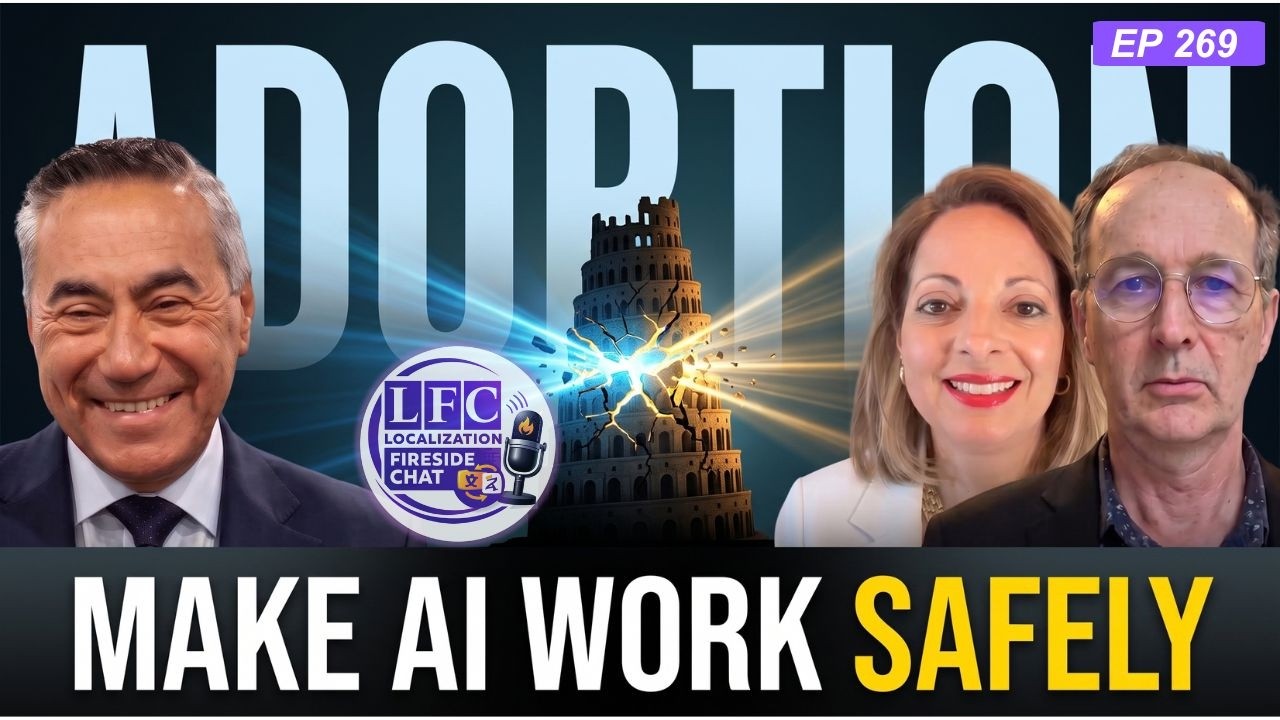
Most organizations do not fail because they lack ambition. They fail because their legal team, their technology team, and their finance team are speaking entirely different languages and nobody is doing the translation. Robin opened episode 269 with exactly that observation, and it set the tone for one of the most practically grounded conversations the Localization Fireside Chat has produced. Sukhi Dhillon Alberga, who leads Legal Strategy and Governance at BLS Consulting, and Andrew Terrett, BLS’s Fractional CTO, are not theorizing about this problem. They built an entire firm around solving it. Sukhi came out of the corporate world before earning her law degree, and that background gave her something most lawyers never develop: the ability to speak to a CEO in business terms before pivoting to compliance risk. Andrew qualified as a solicitor in the UK in the nineties, spent his graduate years doing actual AI research at UBC when it was still considered an academic backwater, and has spent the decades since bridging the gap between lawyers and the technology people they depend on but rarely understand. The synergy between them is not a branding exercise. It shows up in how they talk about their clients and in how directly they are willing to name what is actually going wrong inside organizations rushing to deploy AI.
What Silo Thinking Actually Costs You
The statistic Sukhi dropped early in the conversation is worth sitting with: 88 percent of businesses using AI are not equipped to manage the ethical, legal, and operational risks that come with it. Many of them do not even know what those risks are. Andrew framed the deeper structural problem with a metaphor that cuts through the noise faster than most analyst reports do. AI, he argued, is a general purpose technology like electricity. The electric motor replaced the steam engine over decades, but factories did not immediately transform just because electricity existed. The same dynamic is playing out right now with AI. Organizations are substituting one tool for another without redesigning the workflow underneath it, and that is precisely why the return on investment never materializes. The value, as Andrew put it plainly, is going to come from process redesign, not from picking the right product. Whether it is ChatGPT, Claude, or anything else, the tool selection conversation is the wrong conversation to be having first. Robin reinforced this with a point that should land hard for any executive who has ever signed a customer contract: if that contract specifies that client data cannot leave the country, and your team has plugged your systems into a large language model, you are already in breach. A simple data trace will confirm it. The legal exposure under Canada’s incoming Bill C-36 alone could reach twenty-five million dollars or five percent of global revenue per violation. That is not a compliance footnote. That is an existential risk sitting inside what most teams are treating as a productivity upgrade.
Change Management Is the Real Deployment Problem
The conversation took its sharpest turn when Robin raised the McKinsey finding that Gen Z employees are actively sabotaging AI deployments. Andrew did not hedge. He went straight to the root cause: people do not resist change, they resist change being done to them. If leadership announces that AI is happening and employees should adapt, the reaction is predictable. If leadership instead pulls employees into the redesign process, asks them how their work actually flows, and invites them to see themselves inside the solution, the dynamic shifts entirely. Sukhi connected this to the governance side of the equation by pointing out that organizations also need clarity on who is accountable when something goes wrong. Shadow AI, employees feeding proprietary company data into consumer tools without realizing it constitutes a data leak, is already happening inside organizations that have no policy framework to catch it. The answer to both problems is the same: slow down enough to do the diagnostic work before the deployment, not after. Sukhi’s closing call to the audience was to get excited about AI without getting reckless, and to treat curiosity as the starting point rather than urgency. Andrew’s closing counsel was simpler and perhaps more urgent: step back from the shiny object and get your house in order first, because the governance, the data literacy, the cultural readiness, and the strategic alignment all have to be in place before the tool can do anything meaningful.
This is one of those episodes that rewards a full listen because the texture of the conversation, including where Sukhi and Andrew push back on each other and where they finish each other’s sentences, tells you as much as the content itself does. Watch on YouTube if you want the full dynamic between three people who have all navigated the gap between strategy and execution in real organizations, or Listen on Simplecast if you prefer to take it in on your own schedule. Either way, if your organization is anywhere in the AI deployment conversation, this episode is worth your time before the next decision gets made.
 Robin Ayoub
Leave a comment