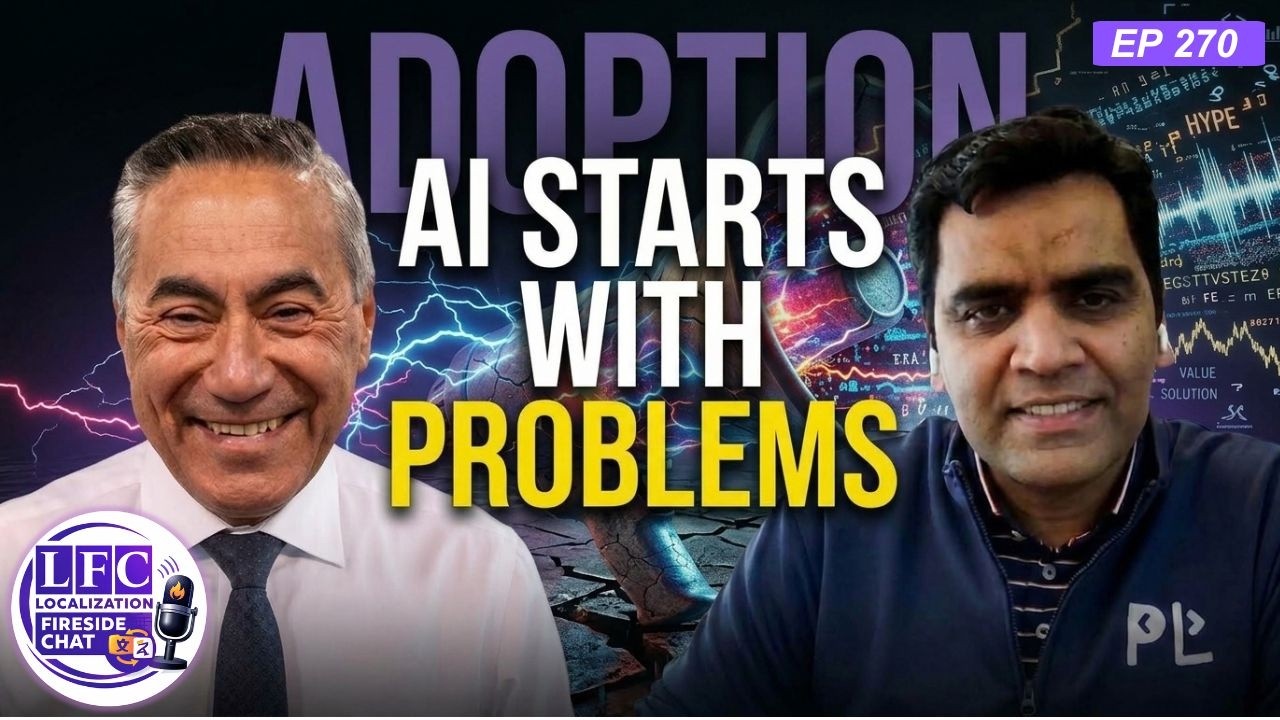
The Question Nobody Asks Before Deploying AI
There is a pattern Robin Ayoub has watched repeat itself across the localization industry and beyond, and it goes something like this: a board tells a CEO to deploy AI, the CEO tells the team to act, and somewhere in the chain the most important question never gets asked. What problem are we actually trying to solve? Muhammad Atif, President and CTO of PureLogics, has spent twenty years building software for clients like Pearson, Intel, Samsung, DHL, and Live Nation, accumulating over four hundred thousand development hours across fourteen hundred products in thirty three countries. His perspective on this particular failure mode is not theoretical. When he sits down with a new client, the first thing he does is slow the conversation down. His four-step framework opens with discovery, where he pulls every relevant stakeholder into a room and works to surface the real business problem before anyone writes a line of code or signs a platform license. He is direct about what he sees in organizations that skip this step: they automate the wrong things faster, they spend budget on tools their teams were never trained to use, and they end up with no way to measure whether any of it worked. The discovery phase produces a roadmap, a timeline, a resource plan, and a projected ROI. Nothing moves until that foundation exists.
Why Localization Is More Than a Translation Problem
One of the sharpest moments in this conversation comes when Muhammad pushes back on a common assumption inside the localization industry. Organizations that treat localization as a translation task are already starting from the wrong place. He walks through everything that actually has to be true for a global product to succeed in a new market: cultural context, regional terminology, local compliance requirements, payment infrastructure, data sovereignty rules, customer support capacity in the right language, and real-time feedback loops that inform product iteration. He uses Uber as an illustration. A version of Uber that works in the United States may need entirely different payment vendors in the Middle East because PayPal and Stripe simply are not the norm there. The infrastructure that hosts the product, the governance rules that govern its data, the time zone coverage for monitoring, all of it has to be reconsidered market by market. Layering AI on top of a product that has not done this foundational work does not accelerate market entry. It amplifies the gaps that were already there, at scale and at speed. That framing, that AI is a multiplier of whatever is already in the system, is one of the clearest and most useful ideas in this episode.
What a Mature AI Adoption Actually Looks Like
Muhammad is not pessimistic about AI. He is precise about it. He describes PureLogics becoming a partner with Anthropic, training certified engineers on Claude, and building evaluation metrics into every engagement so clients can track hallucination rates, token economics, time savings, and resolution rates alongside the usual business KPIs. He is equally clear about what most organizations get wrong before they ever reach that stage. Data quality is non-negotiable. If the inputs are poor, the outputs will be worse, and the speed of AI makes that worse faster. Team education comes before tool deployment, every time. And the idea that burning more tokens is a sign of productivity is something he pushes back on directly, noting that some Bay Area companies are treating token consumption as a success metric when what actually matters is measurable output against a defined business problem. Looking ahead, he sees the next phase of AI not as full automation but as what he calls agentec work, where AI agents operate within defined guardrails and human reviewers own the complete arc from idea to shipment. In regulated industries like healthcare and fintech, he is firm: human judgment stays in the loop. The role of the person changes, but it does not disappear.
This is one of those episodes where the practical utility is high from the first few minutes. If you are a global product leader, a localization program manager, or anyone who has been handed an AI mandate without a clear problem statement attached to it, Muhammad Atif gives you a vocabulary and a sequence for pushing back productively. Watch on YouTube if you want the full conversation with context and body language, or Listen on Simplecast if you prefer audio on your commute. Either way, episode 270 is worth your time.


Leave a comment