The Problem Nobody Is Naming Loudly Enough
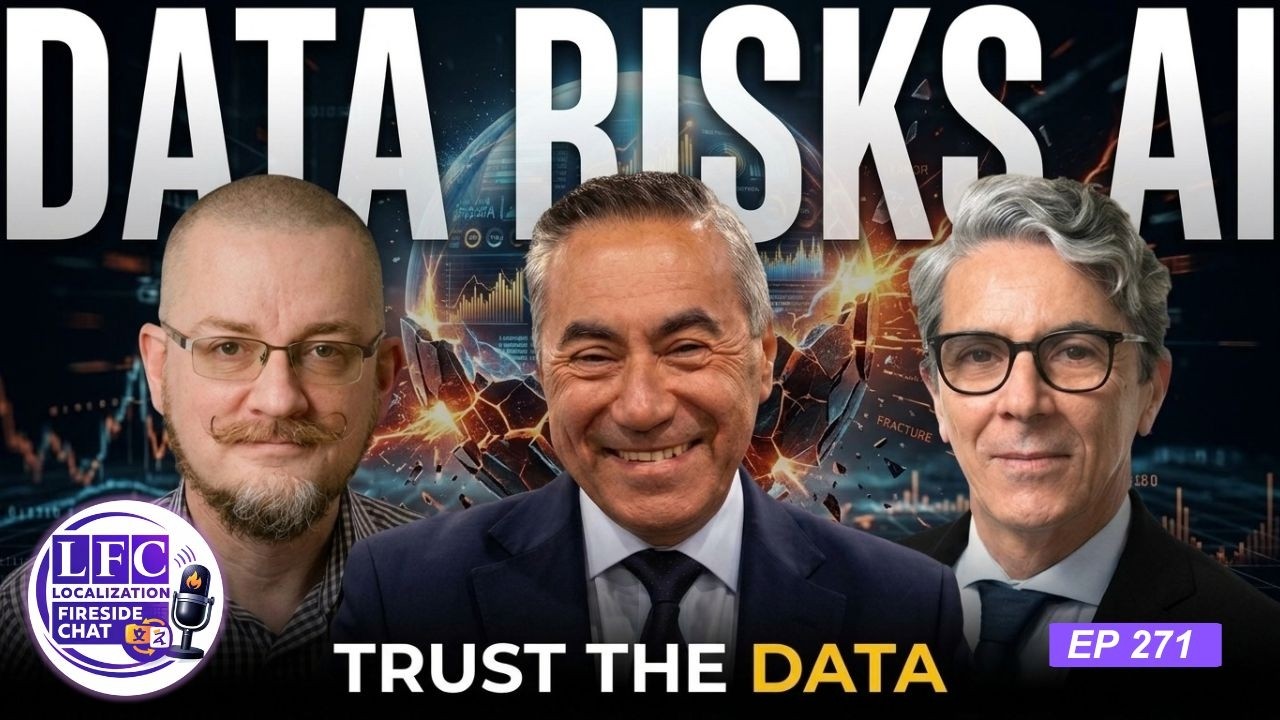
There is a data crisis quietly running underneath every conversation this industry is having about AI, machine translation, and automation. It is not fake data. Fake data, as Tahar Bouhafs points out in this conversation, often gets caught. The real danger is what he calls good enough data, the kind that looks credible, gets passed through unquestioned, and then drives decisions that shape budgets, acquisitions, and market strategies. When CSA Research’s CEO and its VP of Research and Director of Data Services both flag that problem in the same breath, it is worth paying attention. That is exactly what happened in Episode 271 of the Localization Fireside Chat, and the conversation that followed was one of the most grounded and honest assessments of where this industry actually stands that this podcast has produced.
Tahar came to CSA Research from fifteen years at Forrester, and he has been direct from the start about what he brought with him: the commitment to produce market research for the localization industry at the same standard of rigor that other industries take for granted. Arle Lommel arrived through a path that ran from Peirceian semiotics through folklore studies, through LISA, through the German Research Center for Artificial Intelligence where he helped build Multidimensional Quality Metrics, and eventually to CSA Research in 2015. His ethnographic training, the discipline of watching how people actually behave versus how they say they behave, shapes how he thinks about quality in ways that most people building evaluation frameworks never consider. When he says that localization is always first and foremost a cultural issue and that treating it as purely a computational problem puts companies at risk, he is drawing on something deeper than analyst instinct.
What the Data Is Actually Showing Right Now
The industry narrative that suggests consistent double-digit growth does not survive contact with CSA’s methodology. Tahar is direct about it: the data they have, built on representative samples with full statistical validation, shows that the market has been declining for at least the last two years. Once you adjust for inflation, it gets worse. Roughly two thirds of providers in their sample did not grow. And Tahar notes that the sample itself may be underestimating the problem, because some companies chose not to submit data this year precisely because they did not want a bad year on record.
Arle frames what is happening through the lens of a K-shaped economy, and he points out that when he plots company growth and decline by absolute value, it literally makes a K in the data. Some companies are having their best years ever. Others are hemorrhaging revenue. The ones growing have stopped selling translation as a transaction and started selling outcomes: market engagement, regulatory safety, international revenue. The ones declining are still competing on price per word, which Tahar describes plainly as the foundational error the industry made, a race to the bottom that was baked in from the beginning. The real growth, as both of them describe it, will not come from the localization department at all. It will come from going directly to marketing, strategy, and product functions and speaking the language of business value, not word counts.
Trust as the Only Defensible Asset in an AI World
The most important thread running through this entire conversation is trust, and both Tahar and Arle approach it with the same seriousness. CSA Research holds data it does not publish if the sample size does not meet the threshold for statistical validity. Arle describes spotting a competitor’s list that inflated one company’s revenue by a factor of forty, not through malice, but through exactly the kind of unquestioned pass-through that makes good enough data so dangerous. Tahar talks about keeping M&A work so confidential that most of his own research team, including Arle, does not know what deals have been done.
Arle offers the clearest test for deciding who to trust with market data: look for who is exposing complexity and uncertainty versus who is offering a clean, simple narrative. The simple narrative should make you suspicious. The one that says it is complicated and here is what we do not yet know is the one worth trusting. In a moment where AI can generate plausible-sounding analysis at scale, and where the training data for language models already skews so heavily toward English that minority and indigenous languages are built on what Arle calls the equivalent of a single page in the corpus, the cost of trusting unverified data is only going up.
This episode covers a lot of ground that does not get covered honestly very often: what the industry’s real growth numbers look like, why the per-word pricing model was always going to end this way, how ethnographic research shaped a quality metrics framework that is now approaching ISO standardization, and what practitioners should actually do when the available data is thin or mixed. If you want the full conversation, you can Watch on YouTube or Listen on Simplecast, whichever format works best for you. Either way, this is one worth finishing.


Leave a Reply