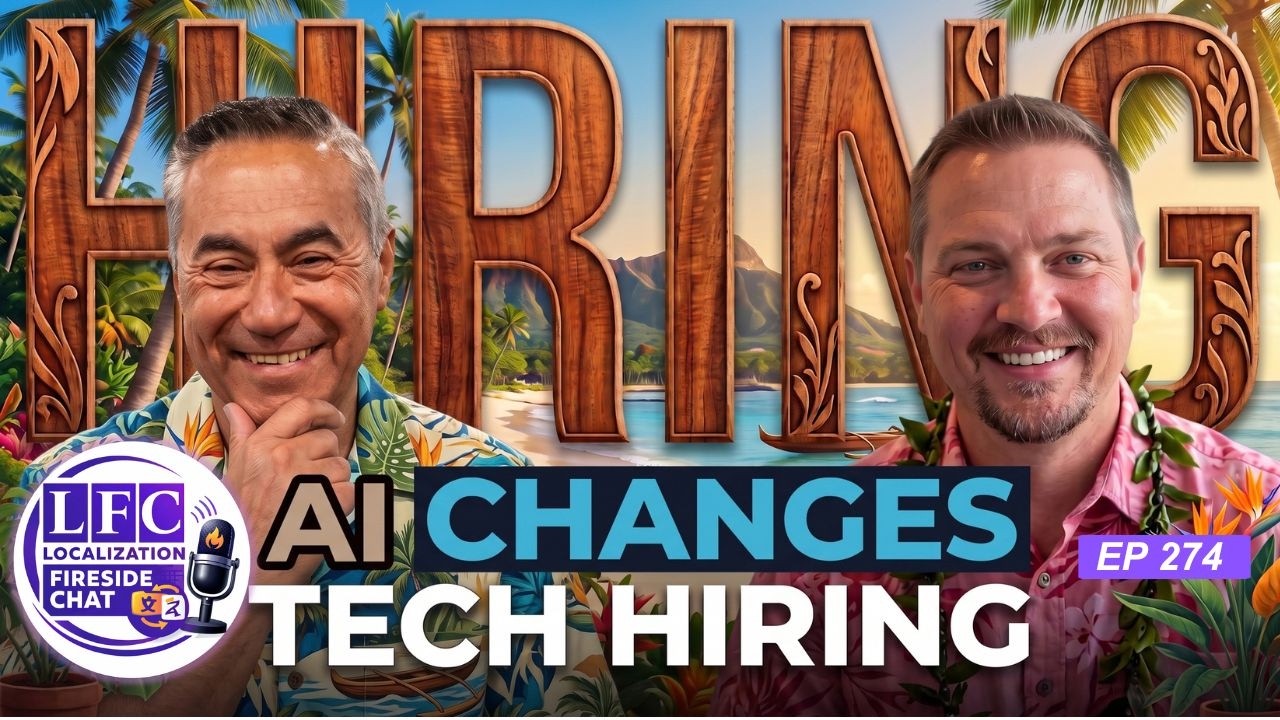
The Conversation Has Changed Since December
When Brian Samson first joined the Localization Fireside Chat back in December, the central argument was that nearshoring Latin American talent was less about saving money and more about maintaining control over how work gets done. Nine months later, he came back for episode 274 with something sharper to say: the companies that understood that early are now pulling ahead, and the ones still shopping on price alone are quietly losing ground. What changed is not the geography. What changed is what senior engineering talent is actually being hired to do. Brian put it plainly during the conversation with Robin: companies no longer need someone to build from scratch. They need someone with enough judgment to know when the AI-generated code is wrong, when it breaks at scale, and how to fit it into a legacy codebase that a vibe-coded prototype was never designed to touch. That shift has moved the Latin American talent market from a cost conversation into a quality conversation, and Brian’s business at Plugg Technologies is growing at roughly sixty percent year over year as a result.
Why English Fluency Outranks Technical Skill on Pay
One of the most counterintuitive moments in the episode came when Brian explained the single biggest driver of compensation across Latin American tech markets right now. It is not seniority. It is not specialization. It is English fluency, specifically the kind that reads as natural rather than scripted, rooted in the same cultural context that US companies operate in. Brian was direct about it: a mid-level developer in Buenos Aires or Bogota who invests in colloquial, conversational English will out-earn a technically stronger peer who cannot move fluidly through a Slack thread or a product review call. What that tells you, Robin pointed out, is that companies are not just buying code when they hire nearshore. They are buying communication, cultural alignment, and the ability to reduce the rework that accumulates when instructions travel poorly across time zones and context gaps. That insight sits at the center of why nearshoring continues to pull away from offshore models even as wages rise in India, the Philippines, and China. The marginal cost difference is narrowing. The marginal benefit of a team that works like an extension of the home office is not.
The Countries Worth Watching and the Mistake That Quietly Kills Engagements
Brian broke down where he is directing attention inside Latin America right now depending on what a company actually needs. Argentina for entrepreneurial full-stack talent. Brazil for data engineering and AI-adjacent work. Mexico for scale and logistics, given its size and proximity to the US. Colombia as a close second across nearly every category. Nicaragua for call center depth. These are not interchangeable markets, and Brian’s argument is that treating them as one undifferentiated region is one of the first signs a company has not thought carefully enough about the hire. The second sign, and the one Brian called the most common failure point he watches play out, is onboarding. Companies that would never let a Toronto-based hire sit for three weeks without a laptop, a manager check-in, or a clear first assignment do exactly that to a Bogota-based engineer and then wonder why the engagement underperforms. The fix is not complicated. Whatever you do for someone remote inside your own country, do it the same way outside it. The problem is not geography. It is attention.
Episode 274 is one of those conversations that earns a second listen because Brian and Robin cover ground that feels practical in the moment and stays with you after. If you want to hear the full exchange, including Brian’s read on where the bull run ends, what M and A activity means for nearshore demand, and why he would rather run a smaller company he controls than a larger one he does not, you can Watch on YouTube or Listen on Simplecast and choose whichever format fits your day.


Leave a Reply