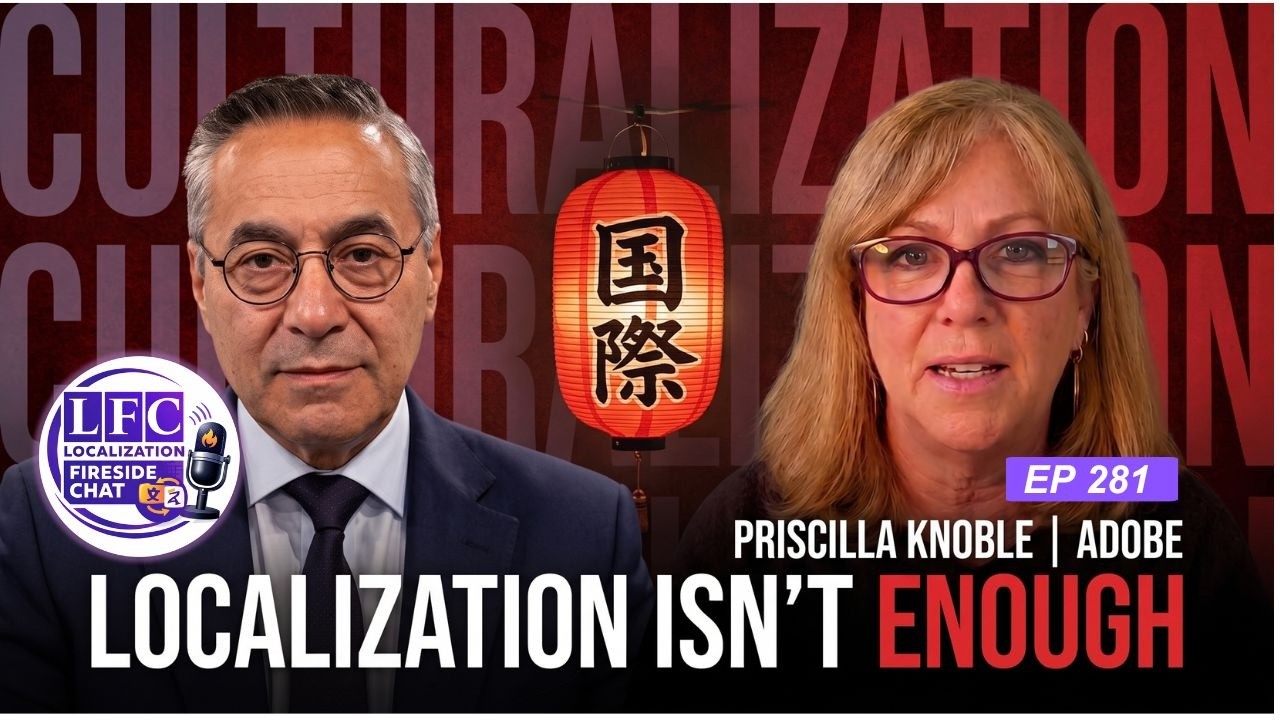
The Path Nobody Could Have Planned
Priscilla Knoble was born and raised in Japan, the daughter of missionaries who settled in a village on the side of Mount Fuji where there were no other foreigners. She played outside in Japanese all day and spoke English at home by her parents’ deliberate design. She went to boarding school in Tokyo at six, came to the United States for university, and spent her twenties teaching first grade and earning a master’s in reading from the University of Washington. None of that sounds like the origin story of a Senior Director of International Strategy and Product Management at Adobe. And yet it is exactly that. What tied it all together was what she calls the Japanese factor, the absence she felt when she moved to the States and realized that almost nothing in her daily professional life touched the culture and language that had shaped her entirely. That absence became the direction. A chance hallway conversation at a localization company in Bellevue, a competing interview at Microsoft in 1996, and she chose Adobe. She has been there, minus roughly six months at Microsoft that she describes with diplomatic understatement, for thirty years.
What Localization Cannot Do Alone
The distinction Priscilla draws between localization and culturalization is not theoretical. It is the product of watching real software fail real users in real markets. Localization, as she defines it at Adobe, is the execution layer. It translates the UI, fits the strings, adjusts the settings, and gets the product into a language a user can navigate. It is fast, it has become faster with AI, and it is essential. But it does not ask whether the product was built for how people in that market actually work. The clearest example she offers is the text engine Adobe built for InDesign in Japan. Western software was architected around a Latin baseline, a horizontal line that characters sit on. Japanese typography does not work that way. Characters are centered within a grid square, not aligned to a baseline. When fonts were mixed, the results were visually broken. Adobe built an entirely new text engine centered on the grid logic Japanese typography actually uses, and it helped move an entire industry from proprietary hot metal type to digital. That is culturalization. It is a business decision, it requires a business case, it involves in-country research and product requirements and sometimes years of development, and it produces something the localized version alone never could: the feeling in a user that this product was made for me.
Where AI Hits the Ceiling
Priscilla is not dismissive of what AI has changed. Adobe’s localization team uses it extensively, and the speed and scale it enables are real. But she is precise about where it falls short, and the example she chooses is deliberately concrete. When Adobe was developing Firefly, she was watching how the model responded to prompts across cultures. Ask it to show you chopsticks and you might get a generic result that would look wrong to anyone who actually uses them, because Japanese chopsticks, Korean chopsticks, and Chinese chopsticks differ in material, length, and shape in ways that are immediately visible to someone from those cultures and invisible to a model trained without that granularity. Ask it for a subway and you might get something that looks nothing like the MTR or the London Underground or the L. The model does not know where you are, and it does not know what belongs there. That gap, between what a system can automate and what requires someone whose finger is genuinely on the pulse of how life looks and feels in a specific market right now, is exactly where Priscilla locates the ongoing human case for culturalization expertise. Localization, she says, gets you in the door. Culturalization keeps you there.
This is one of those conversations that moves between the personal and the structural without losing either. Priscilla talks about sitting at dinner with Adobe’s founders and the head of Morisawa because nobody else on the US side spoke Japanese. She talks about the Japanese quilting publisher she founded in 2011, Stitch Publications, where she was the translator, the layout person, the contract negotiator, and the marketing department simultaneously, and which she eventually sold because Japanese craft books in English, however successful in their niche, were a niche within a niche. And she talks about what it means to build software that is equitable not just in the DEI sense but in the global sense, software that does not merely speak someone’s language but actually belongs in their world. You can Watch on YouTube or Listen on Simplecast and choose whichever format fits how you work best.


Leave a Reply