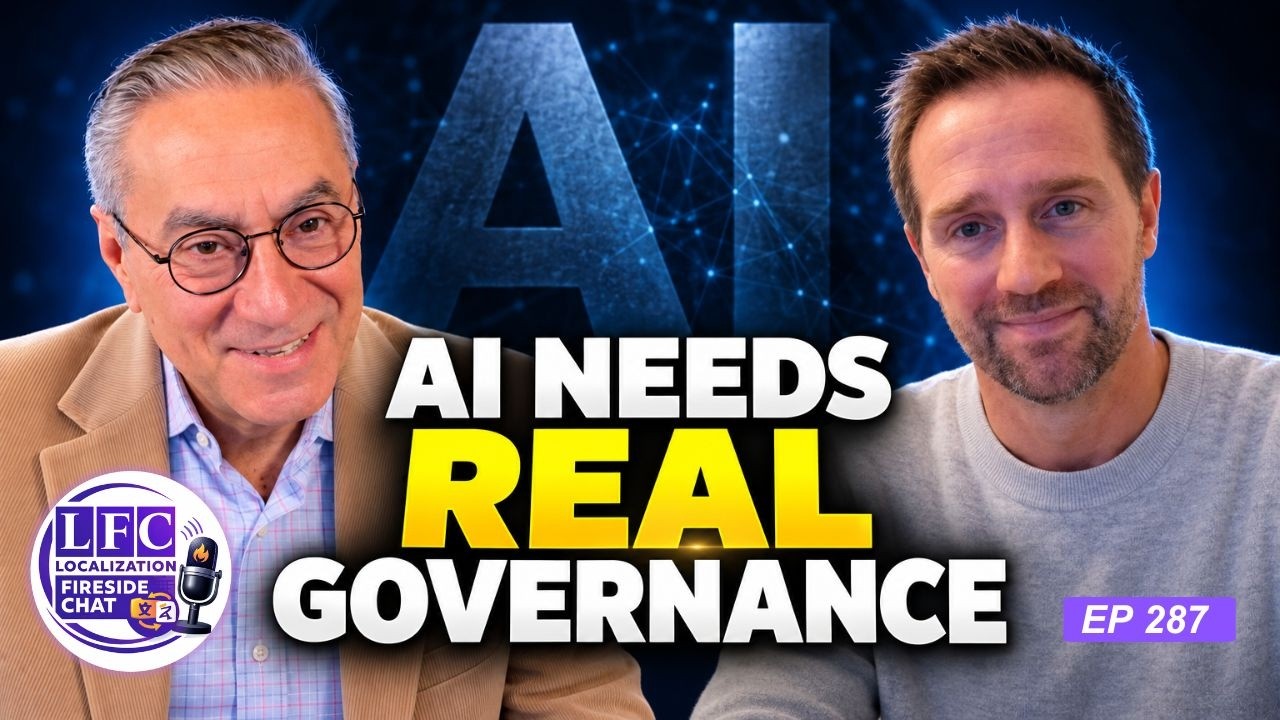
The Gap Between Perceived Reality and Operational Truth
Most executives will tell you they have dashboards, KPIs, audit trails, and governance frameworks. They will tell you, with complete confidence, that they know what is happening inside their organization. James Briers, Founder and CEO of Intelligent Delivery Solutions, has spent over a decade inside compliance-heavy sectors proving that confidence wrong. His argument, which he made with precise clarity in Episode 287 of the Localization Fireside Chat, is not that leaders are dishonest. It is that the systems feeding their decisions are built to comfort rather than reveal. Governance that happens annually, or even quarterly, is not governance at all. It is archaeology. By the time the audit surfaces a problem, the damage is already compounded, the pattern is entrenched, and the cost of fixing it has multiplied far beyond what early detection would have required. James built GovScape specifically to close that gap, not with another dashboard layered on top of existing chaos, but with something he calls Observed Reality, the continuous, cross-system, real-time intelligence of what is actually happening versus what people are reporting is happening.
What Breaks When Governance Is Periodic Instead of Live
The most grounding moment in the conversation came when Robin pressed James for a concrete client example. James described a legal firm struggling with invoice reconciliation across multiple practice management systems, each holding financial data, none of them integrated, and all of them presenting information that looked accurate in isolation but was deeply inaccurate when consolidated. The finance director had no single version of the truth. The annual audit had never caught it because the audit only looked at what was in the systems, not at the integrity between them. GovScape identified the problem in real time by building an abstracted layer across those data sources, surfacing anomalies as they emerged rather than months after they calcified. James made a point that should stay with any operations leader: it is easy for someone to open their CRM, push a stagnant deal’s close date six months into the future, and make a 2 million pound opportunity look active when it will never close. The report looks green. The forecast looks healthy. The board feels reassured. None of it is real. And if you are only running checks every six or twelve months, the distance between the perceived picture and the actual picture grows into something that can threaten the business, or in James’s framing, something that starts to look like cooking the books.
Human Intelligence Is Not Optional, It Is the Differentiator
What makes James’s position interesting is that he is not arguing against AI. He is arguing for the conditions that make AI trustworthy. Garbage in, garbage out is not a new idea, but James applies it with unusual precision. When Robin pushed on where human judgment fits inside an AI-enabled operation, James was clear: the platform generates the intelligence and the task map, but a human still needs to evaluate whether those tasks are legitimate, sequenced correctly, and adding the right value. He described it as almost like consulting that runs alongside the automation rather than being replaced by it. That framing matters because it pushes back hard against the maximalist view that more automation is always the answer. James’s own catastrophic business event, a situation involving former employees that nearly collapsed IDS two and a half years ago, was itself a lesson in observed reality failure. He did not have enough cross-system visibility into his own operations to catch what was happening until it was serious. That personal experience became the intellectual foundation for everything GovScape is built to do. Resilience, he said, is not something you plan for. It is something you develop one problem at a time, and the only way out is through.
If the distance between what you think is true and what is actually true inside your operation is a question you are not asking loudly enough, this episode will push you to start. You can Watch on YouTube or Listen on Simplecast and choose the format that fits your workflow. Either way, James Briers makes the case that the most dangerous thing in your business right now is not a broken process or a bad AI deployment. It is the comfort of believing everything is fine when the data beneath your reports is quietly telling a different story.


Leave a Reply