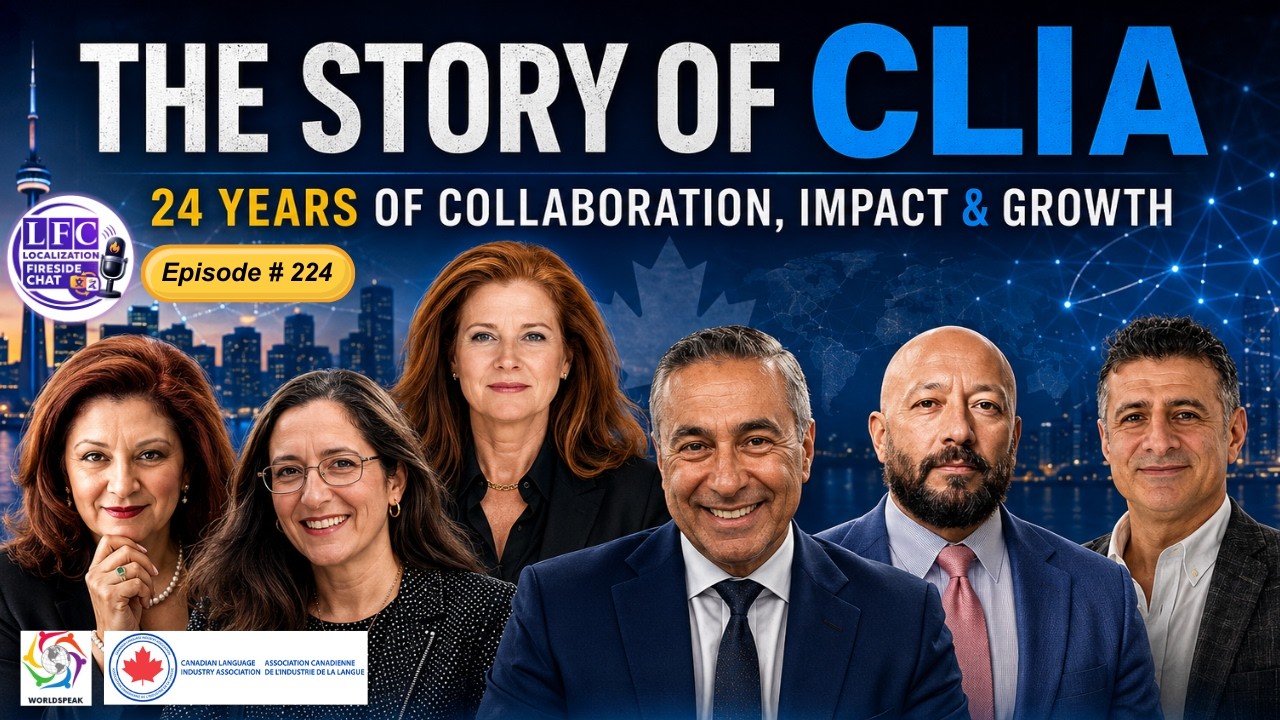
Will CLIA Dissolve or Evolve? The 24-Year Story of Canada’s Language Industry Association
Nobody builds an association expecting it to last 24 years on pure volunteer power.
No salaries. No government safety net. Just a group of language industry professionals who believed the industry needed a unified voice badly enough to give up their evenings, their weekends, and in some cases their own money to keep it alive.
That is the story of CLIA. And it has never been told in full. Until now.
In Episode 224 of the Localization Fireside Chat, recorded live at WorldSpeak 2026, Robin Ayoub sits down with six of the people who built it: Kim Pines, Lola Bendana, Maryse Benhoff, André Palaguine, Paul Penzo, and Peter Madahian.
What Was Missing Before CLIA Existed
Before 2003, Canada’s language industry was fragmented. Companies operated in silos. There was no shared voice, no common standards, no place where competitors could sit down together and talk honestly about the challenges they faced.
Lola Bendana puts it simply: the most important thing missing was the conversation itself.
CLIA, then known as ALIA, was built to fix that. Not with funding or infrastructure or a grand strategic plan. With people who showed up.
The Moment It Almost Ended
Every association has a near-death story. CLIA’s came when government funding was pulled and the organization had to become fully self-sustaining almost overnight.
Kim Pines, who served as treasurer for many years, recalls members being asked to contribute beyond their membership fees just to keep the lights on. One of those moments involved watching a cheque get signed by Larry Rogers in an office that felt like it could be the last day of the whole thing.
It was not the last day. It made the organization stronger.
The Work Nobody Applauds
Most CLIA members benefit from work they never see.
The CGSB Language Services Standard. Canada’s Industry Certification Framework. ISO representation where Canadian delegates show up, Maryse Benhoff notes, as a weight to be taken seriously at the international table.
None of that gets a standing ovation at an AGM. All of it matters enormously to the health of the industry.
A Seat at the Table or on the Menu
Peter Madahian delivers the line that defines the episode:
If you are not a member, you are on the menu, not at the table.
It is not a metaphor. It is a description of what happens to industries that do not advocate for themselves. Standards get set without them. Government relationships get built around them. The industry gets defined by others.
CLIA exists so that does not happen to Canada’s language sector.
What the Founders Would Tell Themselves on Day One
The closing round of the conversation is where the episode earns its place in the archive.
Paul Penzo: it is going to take a while. And then you are going to have to go fast.
Maryse Benhoff: pick your battles.
André Palaguine: everybody deserves a medal. Or therapy.
Lola Bendana: transformation will happen here. Stay on the path.
Kim Pines: there were peaks and valleys. Just like in our own businesses.
Peter Madahian: the rebrand from ALIA to CLIA during COVID was the moment it became real for me.
So Will It Dissolve or Evolve?
The founding members are not nostalgic. They are urgent.
The consensus around the table is that 24 years of slow, careful, volunteer-driven progress has built something real. But the next chapter cannot move at the same pace. The industry is changing too fast. The window to lead rather than follow is narrow.
CLIA will dissolve or evolve depending on what its members decide to do next.
If you are in Canada’s language industry and you are not a member yet, this episode is your invitation.


Leave a Reply