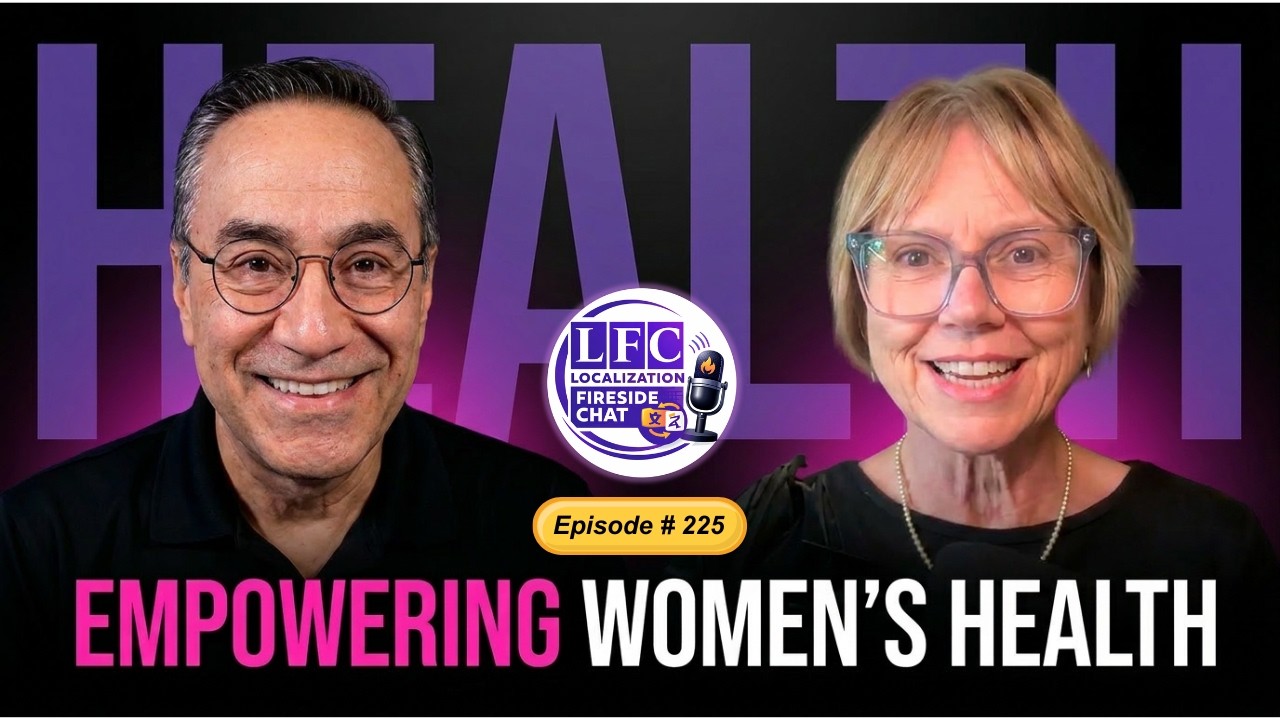
I want to be honest with you. When I booked this conversation, I thought it was going to be
a health tech episode. A founder story. Interesting, but niche.
I was wrong.
What Kirsten Karchmer delivered in this conversation is one of the most important wake-up
calls we have had on this channel in 224 episodes. And I say that having recorded five
episodes on the same day this one went down.
Let me give you the shape of who Kirsten is before we get into what she said.
She is the Founder and CEO of Conceivable Technologies. She is one of North America’s first
board-certified reproductive acupuncturists and a former president of the American Board of
Oriental Reproductive Medicine. She spent 20 years in the clinic. She helped over 10,000
women. And then she did something most clinicians never dare to do. She built technology.
Here is what that technology produced in its first pilot: a 260% increase in the likelihood
of conception. For context, IVF delivers roughly 40%. And her AI did it at one thousandth
the cost.
But that is not even the most striking part. The most striking part is that when the data
scientist came back with the results, Kirsten asked him if the AI had gotten close to her
own clinical results. He said no. It beat her by six percent.
The clinician built something smarter than herself. That is the story.
It Started With Her Own Body
Kirsten did not set out to be a fertility expert. She set out to be a gymnast. She trained
competitively her entire childhood in Dallas and Arlington, Texas. At 19 years old, she was
diagnosed with MS. She could not walk without a cane. Her vision was failing. She was
exhausted all the time.
A friend dragged her to an acupuncturist against her will. She went in skeptical. She came
out changed.
The practitioner said something that stayed with her. He told her that her constitution,
the internal strength of her body, had been depleted by years of extreme training. On the
outside she looked like an Olympic gymnast. On the inside, every system was blown out. His
job, he said, was not to cure her MS. His job was to get her constitution stronger than her
disease.
She went into remission.
That framing, constitution versus disease, strength versus depletion, became the lens
through which she built everything that followed.
The Statistic That Broke Her Open
After two decades in the clinic, a study landed that Kirsten could not ignore. Less than
three percent of couples can afford fertility treatment. That means 97% of people dreaming
of a family will never be able to access a single treatment cycle.
In many countries, one round of IVF costs the equivalent of a full year’s salary. And
unlike almost every other medical technology, IVF has gotten more expensive over the last
40 years, not less.
Kirsten realized she was part of the problem. Her clinic was high-touch, concierge-level
care. Excellent. Inaccessible. So she asked a question that most clinicians never ask:
could software do what she did in the clinic?
She did not believe it could. But she built it anyway.
What Is Actually Breaking Fertility
This is the part of the conversation I want every person listening to sit with.
We have built a culture that is incompatible with reproduction.
Kirsten’s team surveyed 16,000 women and asked them to rate their energy levels on a scale
of one to ten, with no caffeine or exercise for two full days. Sixty percent rated
themselves at six or below. Forty percent rated themselves at four or below.
Making a human being is one of the most resource-intensive things a body can do. We cannot
do it on empty.
Some of the specific factors Kirsten flagged that most people do not know:
Women who do CrossFit are 50% less likely to get pregnant than those who do not. The
research has been done on 16,000 women. The data is clear.
The food supply in North America, even from premium grocery sources, is nutritionally
depleted in ways that Europeans simply do not experience. Kirsten noted that her patients
who travel to Europe consistently report feeling dramatically better despite eating what
they consider to be worse food.
Beauty products. The number of chemical compounds in a typical 20-year-old’s bathroom
routine is staggering, and many of them are endocrine disruptors that interfere with
hormonal balance directly.
Hustle culture. Six hours of sleep presented as a badge of honour. Chronic stress treated
as normal. Cortisol competing directly with progesterone production in ways that quietly
undermine the entire hormonal foundation of fertility.
None of this is being talked about in mainstream fertility conversations. The conversation
jumps immediately to IVF. And Kirsten’s point is that for a large percentage of women,
IVF is not the first answer. It is a shortcut to a very expensive destination when the
underlying problems have not been addressed.
The Menstrual Cycle as a Diagnostic Tool
This was one of the moments in our conversation that genuinely stopped me.
Kirsten built her entire clinical framework around a simple premise: the menstrual cycle
gives women access to 30 days of free diagnostic information every single month. Every
symptom, every shift in energy, every signal the body sends from day one through to the
start of the next cycle is telling a story about internal health.
Most of that information is being ignored.
She became, in her own words, probably the only person in history obsessed with the
menstrual cycle as a diagnostic instrument. That obsession is what allowed her to build
an AI that could eventually read those signals and make personalized clinical
recommendations at scale.
What the AI Actually Does
The platform is called Conceivable. The AI inside it is named after Kirsten herself.
It works across five pillars that Kirsten identified through 20 years of clinical pattern
recognition: energy, blood, temperature, stress, and hormones. The newest version, called
Kai, incorporates tongue photography taken through a smartphone camera, a diagnostic
technique rooted in Traditional Chinese Medicine that maps tongue characteristics to
internal organ systems, combined with wearable sleep data and a detailed intake process.
The pilot results: 105 women seeing Kirsten in the clinic versus 105 women using only the
app with no human contact. The AI outperformed the clinic by six percent. They have 32
patents and counting.
Women’s Health Is Not a Solved Problem
I want to close with something Kirsten said near the end of our conversation, because I
think it deserves to land without commentary.
I asked her about the state of women’s health more broadly. Not just fertility. Women’s
health at every stage of life.
She said: nothing is solved. Not one thing in women’s health is currently being done right,
except prescribing medications.
That is a serious statement from someone who has spent a career inside this system. I
believed her when she said it. And I think after you listen to this conversation, you will
believe her too.
Listen and Watch
This conversation is available in full on YouTube and on all audio platforms.
Watch on YouTube: https://youtu.be/K4Q0P2SHeT4
Listen on Simplecast: https://localization-fireside-chat.simplecast.com/episodes/the-ai-that-outperformed-the-doctor-kirsten-karchmer-founder-ceo-conceivable-technologies-ep-224
Connect with Kirsten Karchmer
Website: https://conceivable.com
Instagram: https://www.instagram.com/conceivable.official/
Facebook: https://www.facebook.com/conceivablefertility
LinkedIn: https://www.linkedin.com/in/kirsten-karchmer-0139808/
If you want to connect with Kirsten directly or learn more about getting involved with
Conceivable Technologies, reach out to me at l10nfiresidechat@gmail.com and I will make
the introduction personally.


Leave a Reply