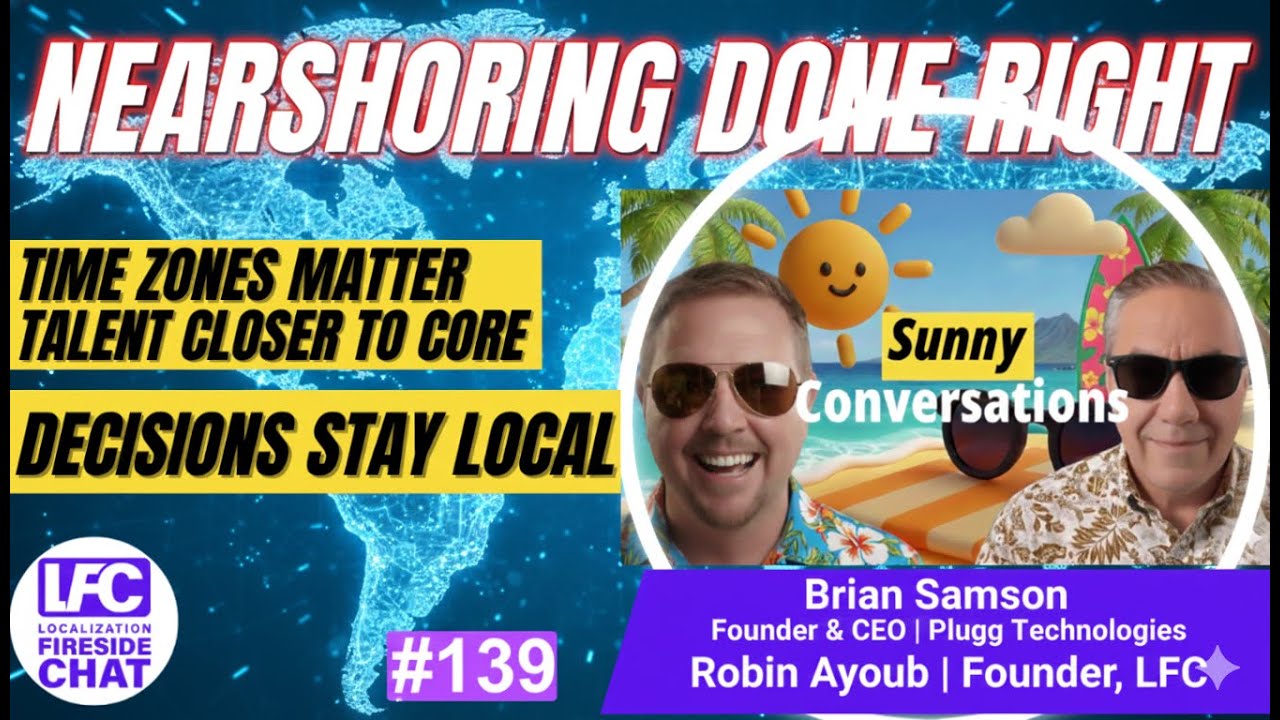
The Vocabulary Problem That Costs Companies Real Money
Robin Ayoub opened by asking Brian Samson to untangle three terms that get misused constantly in business conversations: nearshoring, offshoring, and outsourcing. Samson’s breakdown is practical enough to save a company from a genuinely expensive hiring mistake. Outsourcing simply means a function is handled outside your organization, geography irrelevant. Offshoring and nearshoring both describe where that work happens, but the difference between them is an ocean and, more importantly, a twelve hour time gap. For U.S. and Canadian companies, offshoring typically means Asia, and nearshoring means Latin America, same working hours, same Slack windows, same afternoon standup calls. Samson connected this directly to what he called the rubber band effect after COVID. Remote work stretched teams across every time zone imaginable, and companies quickly discovered that an email answered half a day later or a Zoom call nobody could join because the other team was asleep carries a real operational cost. The rubber band snapped back toward alignment, and that snap is exactly the argument nearshoring makes for itself.
Why English Fluency Outweighs Technical Skill on Pay
One of the more counterintuitive moments in the conversation came when Samson explained what actually drives compensation for Latin American tech professionals. The answer is not what most hiring managers expect. A technically strong engineer with moderate English will often earn less than a moderately skilled engineer with advanced, colloquial English fluency, the kind built by years of watching English language shows and absorbing slang and cultural references. Samson described these professionals as climbers, people deliberately developing two parallel skill sets, domain expertise and language, because they understand which one opens the bigger doors. This is also why Plugg Technologies focuses almost entirely on senior talent rather than junior candidates. Companies hiring nearshore want a senior professional at something closer to a junior domestic cost, and senior candidates typically already clear both bars, strong skills and strong communication, which removes the friction that can quietly derail a distributed team before anyone names the problem.
Control, Capital, and Why Samson Funds His Own Companies
The sharpest exchange in the episode came when Ayoub, drawing on his own experience sitting through three or four private equity transactions, asked Samson directly why Plugg Technologies has grown on organic capital alone. Ayoub read him plainly: “you strike me as I want to be independent I want to run my own show leave me alone kind of guy.” Samson confirmed that read and then explained why. He had raised roughly two million dollars in an earlier nearshore venture and described realizing almost immediately that the business no longer felt like his own company, even at a minority stake. That experience shaped every funding decision since. What Samson draws a careful line around, though, is the difference between capital and partnership. He told Ayoub that nothing genuinely good in his business career has come from anything other than a relationship, and he described actively seeking partnerships that create mutual value without requiring him to hand over equity or decision making authority. That distinction, partnership over investment, is a more nuanced position than simple bootstrapping ideology, and it reflects the same instinct toward control that runs through his thinking on nearshoring itself. Time zone alignment, English fluency, single entity invoicing, Plugg’s model is built to give clients clarity and control over a hire without forcing them to manage the operational complexity underneath it.
If this conversation sparked a question about how nearshore hiring might work inside your organization, the full episode is worth your time in whatever format fits your day. Watch on YouTube if you want the uncut conversation with full context, or Listen on Simplecast if you prefer to take it with you. Either way, Samson’s eleven years of placements and hard won perspective on capital and control make this one of the more practical nearshoring conversations Robin Ayoub has put on record.


Leave a comment