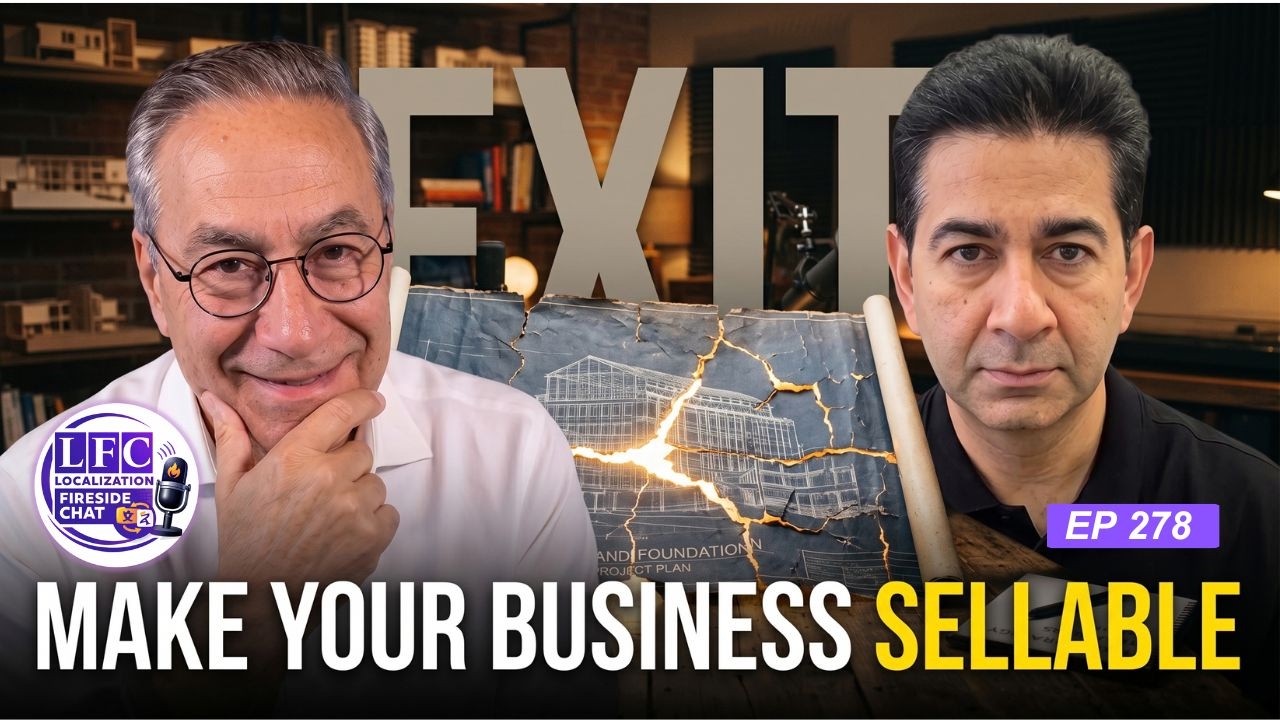
The Founder Trap That No Financial Statement Will Show You
Most business owners assume that a profitable business is a sellable one. Nitin Khanna, Founder and President of N3 Business Advisors Inc., has spent sixteen years proving that assumption wrong. In episode 279 of the Localization Fireside Chat, Nitin draws a line that every founder needs to hear clearly: a profitable business does not automatically become a transferable business. Those are two different journeys, and confusing them is the single most expensive mistake an owner can make. He has watched deals fall apart not because the numbers were bad, but because everything of real value, the relationships, the reputation, the institutional knowledge, lived entirely inside one person. When a buyer’s due diligence team starts pulling on that thread, the whole deal can unravel fast.
Nitin came to this work through an unusual path. He grew up in a business family, started his first company at fifteen in India, immigrated to Canada in 2001, and landed his first job inside the construction industry itself, working in finance at Carillion Construction and then at Aecon. After nearly a decade in large corporate environments, he recognized something important: the small subcontractors those giants hired had no systems, no documented processes, no second layer of leadership, and no plan. He left the corporate world in 2010, went door to door asking business owners if they wanted help selling, and built what has become Canada’s leading M&A advisory firm focused exclusively on the construction sector. The CFA designation he holds is not decorative. It signals, as Robin noted in the opening, that the numbers in any deal Nitin touches are being taken seriously.
What Buyers Find That Sellers Never Expected to Be a Problem
When Robin asked what buyers most commonly discover during due diligence that sellers genuinely did not anticipate, Nitin’s answer was immediate: all the relationships are owned by the owner, not the company. It does not show up on a balance sheet. It does not appear in an income statement. But the moment a serious buyer starts mapping out what actually transfers in the transaction, owner dependency becomes the fault line everything else cracks along. Nitin shared a story where a deal was fully structured, financing arranged, share purchase agreement ready to sign, and then the seller disclosed that a critical property lease had been agreed to on a handshake. The landlord refused to transfer it. The deal collapsed. That handshake cost the seller approximately three million dollars, which Nitin estimated represented roughly ninety percent of their net worth.
He also made a point that reframes the entire PE conversation. Many construction owners resist selling to private equity because they want a buyer who understands their business. Nitin’s response to that is direct: if your business can only be bought by someone who already understands it deeply, that is not a buyer problem, that is a transferability problem. You built something that depends on context only you carry. Fix that, and your buyer pool expands dramatically. Fix it well enough, and private equity, which often pays higher multiples than strategic buyers, becomes a real option rather than a last resort.
Build It Backwards, Exit Before You Sell
The two most quotable moments in this conversation came right at the close, and they deserve to sit next to each other. When Robin asked what a founder five years from exit should start working on today, Nitin said: stop making the business depend on you. Take ninety days off, do not look at your phone or your email, and whatever breaks is exactly what needs to be fixed. That is not a test of your team. That is a diagnostic of whether you actually have a business or whether you have a very complicated job with your name on the door.
The second came when Robin asked what the most common misconception about M&A is among construction owners. Nitin’s answer reframed the entire conversation: everybody thinks they need to sell the business. They don’t. They need to exit the business. Selling is a transaction. Exiting is a mindset shift that has to happen long before any buyer shows up. For anyone in the localization industry, professional services, or any founder-led business watching consolidation accelerate around them, that distinction is the one worth writing down.
This is a conversation worth sitting with in full. You can Watch on YouTube or Listen on Simplecast and choose the format that works best for you. If anything Nitin said connects with where your business is right now, reach out through the blog and Robin is happy to make an introduction.


Leave a Reply